
2026-08-29 Sat
The princely state of Mysore occupies an important place in the history of South Indian coinage. Ruled for centuries by the Wodeyar dynasty, Mysore developed a distinctive monetary tradition that drew heavily upon the artistic and religious conventions of the Vijayanagara Empire.
Krishna Raja Wodeyar III (1799–1868) was one of the longest-reigning rulers of Mysore. He ascended the throne at a crucial period following the defeat of Tipu Sultan in 1799. As the young ruler came to power, the administration of the state was initially guided by his celebrated Dewan, Purnaiah (Purnaiya), who played an important role in reorganizing Mysore’s administration and finances.
Krishna Raja Wodeyar III presided over a period in which Mysore gradually restored its traditional institutions and royal identity. His reign also witnessed the continuation and development of the state’s distinctive coinage. Contemporary Mysore gold issues followed established Vijayanagara-derived standards, while incorporating symbols and legends associated with the Wodeyar ruler.
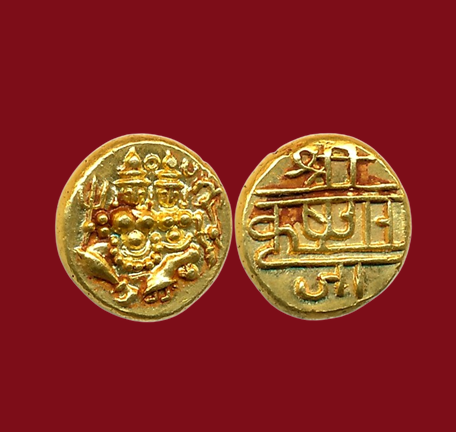
Under Krishna Raja Wodeyar III, the traditional design featuring Shiva and Parvati was retained. This was not merely an artistic choice. The sacred imagery connected the coin to the religious and cultural traditions of the region while simultaneously continuing a long-established South Indian numismatic design.
The obverse of this remarkable coin depicts Lord Shiva seated with Goddess Parvati. Shiva is shown holding his traditional attributes, including the trident and deer, while Parvati is seated upon his lap. The sun and moon appear above the divine couple. The reverse carries the ruler's name in Devanagari script, arranged in three lines, “Sri / Krishna Ra / ja”.
-
Baroda Last Ruling Maharaja Pratap Singh Gaekwad’s Rare Mohur
2026-08-29 Sat -
An Iconic Coin of the Sangam Pandyas Features Elephant, Trident and Man
2026-08-28 Fri -
An Ancient Sangam-Age Chera’s Copper Coin
2026-08-28 Fri -
Elephant and Lion Depicted on Sangam Chola Coinage
2026-08-27 Thu -
A Coin from Ancient Tamilakam – Elephant and Tiger of the Cholas
2026-08-27 Thu