
2026-08-29 Sat
The princely state of Baroda, ruled by the Gaekwad dynasty, was among the most prominent and prosperous states of western India. The Gaekwads rose to power in Gujarat during the 18th century under the Maratha political order, eventually establishing Baroda as a powerful and comparatively progressive princely state. Their coinage evolved from early issues struck in the name of the Mughal emperor to distinctive coins bearing the names, symbols and portraits of the Gaekwad rulers.
Pratap Singh Rao Gaekwad (1908–1968) belonged to the Gaekwad dynasty of the Marathas. He ascended the throne on 6 February 1939, following the death of Sayajirao Gaekwad III. His reign coincided with the final decade of British paramountcy, India's Independence in 1947, and the subsequent integration of princely states into the Indian Union.
Pratap Singh continued the educational and institutional legacy associated with Baroda's royal family. Among the important institutions connected with his reign was the Maharaja Sayajirao University of Baroda, established in 1949, with Pratap Singh serving as its Chancellor during 1949–1951.
The Mohur was not simply a conventional circulating coin. Issues of this type are associated with the ceremonial and commemorative traditions of the late princely states, when royal coinage could serve as a powerful expression of sovereignty, dynastic identity and royal prestige.
The use of a portrait of the Maharaja was itself significant. Earlier Baroda coinage had gradually moved from Mughal-style monetary conventions toward coins bearing the identity and portrait of the Gaekwad ruler. The Pratap Singh Mohur represents the culmination of that evolution.
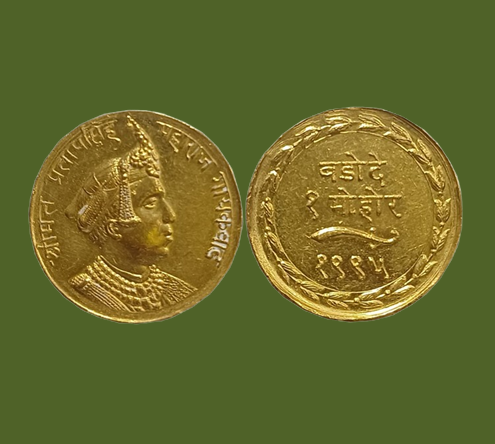
The obverse presents a finely engraved bust of Maharaja Pratap Singh facing right, wearing his royal headdress and ornaments. Surrounding the portrait is the Devanagari legend: “Srimant Pratap Singh Maharaj Gayakwad”.
The reverse carries the essential monetary information: Baroda, the denomination 1 Mohur, and the date 1995 in the Vikram Samvat calendar. The design also incorporates the Gaekwad scimitar, an important dynastic emblem.
The use of Vikram Samvat rather than the Gregorian calendar reflects the continued Indian character of Baroda's state coinage. The date VS 1995 corresponds to 1938–39 CE, placing the issue precisely at the moment when Pratap Singh was succeeding to the Baroda throne.
-
Shiva-Parvati in Gold: The Sacred Varaha of Krishna Raja Wodeyar III
2026-08-29 Sat -
An Iconic Coin of the Sangam Pandyas Features Elephant, Trident and Man
2026-08-28 Fri -
An Ancient Sangam-Age Chera’s Copper Coin
2026-08-28 Fri -
Elephant and Lion Depicted on Sangam Chola Coinage
2026-08-27 Thu -
A Coin from Ancient Tamilakam – Elephant and Tiger of the Cholas
2026-08-27 Thu