
2026-08-28 Fri
The Pandyas were one of the three great Tamil dynasties of the Sangam age, alongside the Cheras and Cholas. Their ancient kingdom was centred around Madurai and the fertile regions of southern Tamilakam, with access to the pearl-rich fisheries of the Gulf of Mannar. Their connections with maritime trade also brought the Pandyan kingdom into contact with the wider Indian Ocean world.
Among the most recognisable symbols associated with the Pandyas is the fish, which became their characteristic dynastic emblem. Early Pandyan coinage is therefore especially important, as it provides some of the earliest surviving material evidence for the symbols and political identity of the dynasty.
The Sangam-age Pandyas coinage is predominantly made of copper and is notable for its rich combination of animals, religious symbols, plants and geometric motifs. The fish motif is particularly significant. Other motifs—including trees within railings, standards, flowers, vessels, conches, wheels and crescents—reflect the broader symbolic traditions of early Indian coinage.
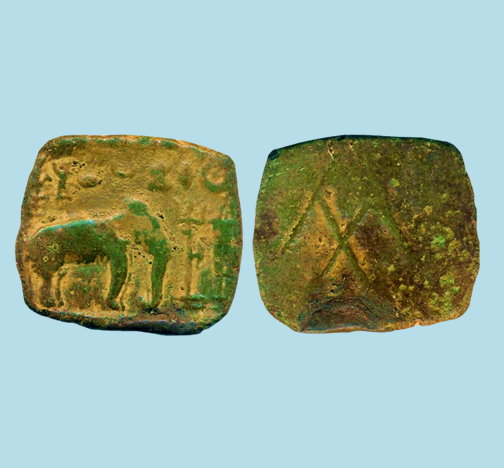
Here, the copper coin weighs 7.32 g. It is known as the “Elephant Trident Man” type, is an especially elaborate example of early Pandyan coinage.
The obverse of the coin depicts, an elephant stands facing right. Beside it is a trident-axe standard enclosed within a railing, while a standing human figure appears on the right. Above the elephant is an extraordinary row of symbols. From left to right, these comprise a railed tree, Indra-dhvaja (Indra's standard), flower pot, crescent, Srivatsa, conch and wheel.
The reverse is dominated by a stylised fish—the defining symbol of Pandyan identity. Its presence makes the attribution particularly compelling and links the coin to the long tradition of the fish emblem that continued in later Pandyan coinage.
More than two millennia later, this small copper coin continues to preserve the symbols, artistic traditions and dynastic identity of the Sangam-age Pandyas, making it a remarkable piece of early South Indian numismatic history.
-
Mithuna (Couple) Type Coin from the Post-Mauryan Ujjaini Region
2026-11-17 TueContinuing our exploration of the distinctive coinage of the Post-Mauryan Ujjaini region, let us ...
-
Lord Shiva Standing Type Copper Coin of the Ujjaini Region from Post-Mauryan Period
2026-11-17 TueThe Post-Mauryan period (200 BCE–300 CE) witnessed the emergence of several regional kingdoms, ...
-
Rare Silver 1½ Shana Punch-Marked Coin of Panchala Janapada
2026-11-16 MonThe Panchala Janapada was one of the sixteen Mahajanapadas of ancient India, flourishing during t...
-
Earth God on Panchala Copper Coin of King Bhumimitra
2026-11-16 MonThe ancient kingdom of Panchala was one of the prominent Mahajanapadas of northern India. Located...
-
Silver Punch-Marked Coin of Vidarbha Janapada – Melghat Region
2026-11-13 FriThe emergence of Janapadas during the ancient period marked an important phase in India's politic...