
2026-08-21 Fri
The history of Tanjore (Thanjavur) entered a new chapter in the second half of the 17th century. After the decline of the Tanjore Nayakas, political instability opened the way for the rise of a new ruling house. It was in this turbulent period that Venkoji, also known as Ekoji I, established Maratha rule in Tanjore.
Venkoji was the son of Shahaji Bhonsle and the younger half-brother of the celebrated Maratha ruler Chhatrapati Shivaji Maharaj. Before his rise in Tanjore, Venkoji had served the Adil Shahi Sultanate of Bijapur and acquired considerable military experience.
The Venkoji's accession date vary among historical sources, with dates between 1674 and 1676 being cited. His greatest achievement was undoubtedly the establishment of an independent Maratha kingdom in Tanjore. This created a southern branch of the Bhonsle dynasty that survived for nearly two centuries, until the annexation of the kingdom by the British in 1855.
His reign coincided with a period of intense political competition in South India. The new Tanjore kingdom had to navigate relations with the Nayakas of Madurai, Mysore, the Bijapur and Mughal powers, and other regional forces. Venkoji's position was further complicated by the southern expedition of his half-brother Shivaji in 1676–77, undertaken partly to assert Shivaji's claim to the territories associated with their father Shahaji.
Historical accounts credit him with repairing and constructing irrigation canals and tanks and bringing fallow land under cultivation, important measures in the fertile Kaveri delta where agriculture was central to the economy.
His reign therefore represents an important transition: a Maratha military family from the Deccan became the ruling dynasty of one of the richest agricultural regions of southern India.
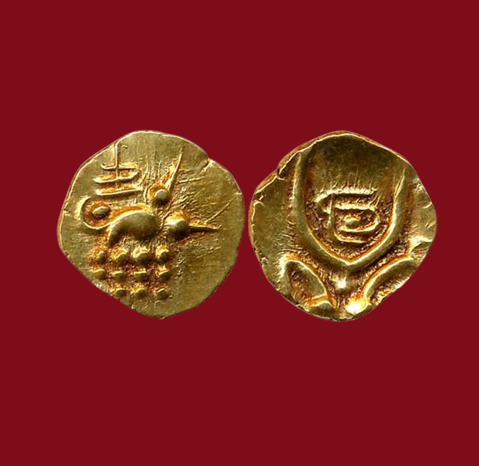
Venkoji’s coinage is among the most fascinating early issues of the Tanjore Marathas. His gold fanams are extremely small, generally weighing around 0.35–0.40 grams. They carry distinctive designs that combine South Indian artistic traditions with symbols associated with the new Maratha rulers.
Several varieties are known. One type bears a stylized lion and a dagger, while another has a Devanagari “Ve” and an animal design on the reverse. Numismatic references catalogue Venkoji's issues under different systems, including the types listed by Maheshwari & Wiggins and K. Ganesh. This coin is a small gold fanam weighing 0.38 grams, yet its compact design preserves several distinctive features of early Tanjore Maratha coinage.
The obverse of the coin depicts a lion facing right, with a crescent above. Beside or within the design appears the Devanagari letter “Ve”, generally understood as an abbreviation connected with Venkoji. The reverse features a stylized boar, accompanied by a small symbol above.
-
Golden Lion on Tanjore King Sarabhoji I’s Fanam
2026-08-21 Fri -
Rare Gold Gadyana of Barma Bhupala of Torgal: Local Power in the Kalachuri Deccan
2026-08-20 Thu -
Rare Gold Lakshmi Coin of King Naravarman, Paramara of Malwa
2026-08-20 Thu -
Trident and Dagger on Sri Khengarji III’s Coin of Kutch
2026-08-19 Wed -
Copper 3 Dokdo of Nawanagar’s King Jam Sri Vibhaji II
2026-08-19 Wed