
2026-08-21 Fri
The historic city of Tanjore (Thanjavur) in Tamil Nadu has long been one of the great cultural centres of South India. It flourished under the Cholas and later came under the rule of the Nayakas of Tanjore.
In 1674–75, Ekoji I (Venkoji), the half-brother of the celebrated Maratha ruler Shivaji, established Maratha rule in Tanjore. His conquest brought the city under the Bhonsle dynasty, which continued to rule the Thanjavur region until the 19th century.
The Thanjavur Marathas were distinctive in the cultural history of South India. Although their ruling house was Maratha and Marathi remained important at court, they inherited and continued the rich Tamil literary, artistic and religious traditions of the region. Tanjore remained an important centre of learning, temple culture, music and the arts under the Maratha rulers.
Sarabhoji I, also known as Serfoji I or Sarabhaji I, was born in 1675 as the son of Ekoji I. He became Raja of Tanjore in the early 18th century and ruled until 1728. He was the third ruler of the Thanjavur Bhonsle dynasty.
His reign was important in consolidating Maratha authority in the Tanjore region. Sarabhoji was also a patron of arts and literature, continuing the tradition of making Tanjore a significant intellectual and cultural centre. His reign also brought the Tanjore kingdom into the complex politics of neighbouring states.
The coinage of the Tanjore Marathas is particularly interesting because it reflects the South Indian monetary traditions inherited from earlier kingdoms while also carrying the identity of the new Maratha rulers.
Among the most attractive and intriguing issues are the tiny gold fanams. Fanams were small-denomination gold coins widely used in South India and neighbouring regions. Their diminutive size required remarkably compact designs, with religious symbols, animals and legends reduced to a few carefully engraved elements.
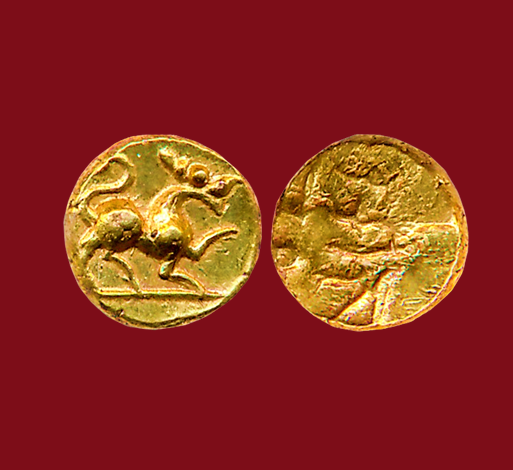
Coins attributed to Sarabhoji I include gold fanams featuring a lion on the obverse and a Nagari/Devanagari legend referring to Sarabha on the reverse. The attribution of some of these lion-and-Sri Sarabha fanams to Sarabhoji I is regarded by specialists as tentative.
Here, the coin is a remarkable gold fanam weighing just 0.37 grams. Despite its tiny size, it carries a clearly recognizable design on both sides.
-
Rare Fanam of the First Tanjore Maratha: Venkoji’s Golden Legacy
2026-08-21 Fri -
Rare Gold Gadyana of Barma Bhupala of Torgal: Local Power in the Kalachuri Deccan
2026-08-20 Thu -
Rare Gold Lakshmi Coin of King Naravarman, Paramara of Malwa
2026-08-20 Thu -
Trident and Dagger on Sri Khengarji III’s Coin of Kutch
2026-08-19 Wed -
Copper 3 Dokdo of Nawanagar’s King Jam Sri Vibhaji II
2026-08-19 Wed