
2026-08-20 Thu
The Paramaras was centred in Malwa, with Dhara (modern Dhar) as its capital. The dynasty rose to prominence from the 10th century and reached its greatest political and cultural stature under rulers such as Vakpati-Munja and Bhoja. The Paramara kingdom became renowned not only for its military ambitions but also for its patronage of literature, architecture, learning and the arts. It became an important centre of intellectual and atistic activity, with Dhara celebrated as a seat of learning. They were marked by constant rivalry with neighbouring powers, including the Chaulukyas of Gujarat, the Western Chalukyas of Kalyani, the Kalachuris of Tripuri and the Chandelas.
After Bhoja's death, the kingdom was ruled by several successors, among them Udayaditya, who helped restore Paramara authority following a period of political instability. Udayaditya was succeeded by his son Naravarman, who ruled Malwa approximately from 1094 to 1133 CE. An inscription records Naravarman as the son of Udayaditya, while earlier records show him making a land grant during his father's lifetime.
Naravarman's reign came at a time when Paramara power was facing increasing pressure from neighbouring kingdoms. Paramara inscriptions of his period provide valuable evidence for the dynasty's administration, religious patronage and genealogy. His surviving records demonstrate the continued use of Sanskrit and Nagari script in royal and religious contexts.
The coinage of the Paramaras is particularly interesting because it reflects the monetary traditions of early medieval north and central India. Gold issues of the Paramaras commonly employ a religious image on the obverse and a dynastic legend in Nagari on the reverse.
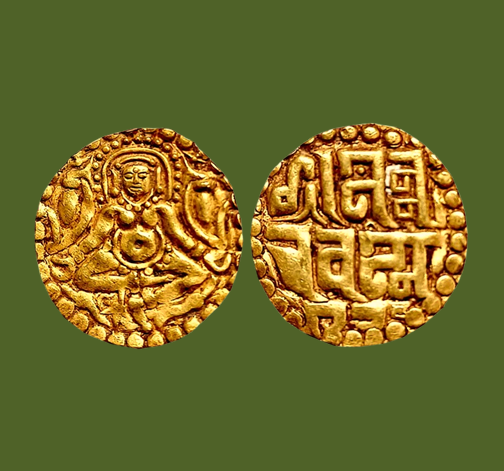
A characteristic Paramara gold type features Goddess Lakshmi seated facing, while the reverse carries the ruler's name in Nagari/Devanagari. This Lakshmi type is associated with several Paramara rulers, including Udayaditya and Naravarman.
Lakshmi, the goddess associated with prosperity and abundance, appeared on precious-metal currency. The combination of a recognizable religious icon with a ruler's name provided both an auspicious visual symbol and a means of identifying the issuing authority.
Here, the coin is of Naravarman's Lakshmi type. The denomination of the gold coin is 4 ½ Masha and it weighs 4.04 g. The obverse of the coin depicts seated Goddess Lakshmi facing front. The reverse carries Devanagari legends, “Shri Manna-ra Vamma (Deva)” arranged in three lines, within a dotted border.
-
Rare Gold Gadyana of Barma Bhupala of Torgal: Local Power in the Kalachuri Deccan
2026-08-20 Thu -
Trident and Dagger on Sri Khengarji III’s Coin of Kutch
2026-08-19 Wed -
Copper 3 Dokdo of Nawanagar’s King Jam Sri Vibhaji II
2026-08-19 Wed -
Jai Hind – The Final Coinage of Kutch State
2026-08-18 Tue -
Nawanagar Silver 5 Kori of Jam Shri Vibhaji II
2026-08-18 Tue