
2026-08-20 Thu
Kalachuris of Kalyani emerged as a significant power in the Deccan during the 12th century. Their realm encompassed parts of present-day Karnataka and Maharashtra, and their political influence extended through a hierarchy of feudatories and local rulers.
The Kalachuri capital was Kalyani, the historic city corresponding to present-day Basavakalyan in Karnataka. Their period of ascendancy was relatively brief, but it was an important phase in the political and cultural history of the Deccan. The reign of Bijjala II is also closely associated with the Virashaiva/Lingayat movement, which flourished in Karnataka during the 12th century and was associated with figures such as Basavanna, Allama Prabhu and Akka Mahadevi.
Kalachuri rule depended heavily upon a network of subordinate chiefs and feudatories who administered different territories while acknowledging the authority of the ruling house. Local rulers could exercise considerable autonomy, and some maintained their own political identities, titles and coinage.
Barma Bhupala is one such local ruler, remembered today primarily through his exceptionally rare gold coinage. Torgal was governed by local chiefs who operated within the wider political framework of the dominant Deccan powers.
His coins provide valuable evidence for the political organisation of the period. Rather than simply reflecting the authority of a major imperial dynasty, they reveal how local rulers and feudatories could assert their own identity through inscriptions, titles and distinctive coin types.
The Gadyana was not restricted to a single dynasty. Gold pieces of broadly similar weight standards were issued by different rulers across the Deccan, including the Western Chalukyas, Hoysalas and other regional powers and chiefs. Their designs and inscriptions, however, provide important clues to the issuing authority.
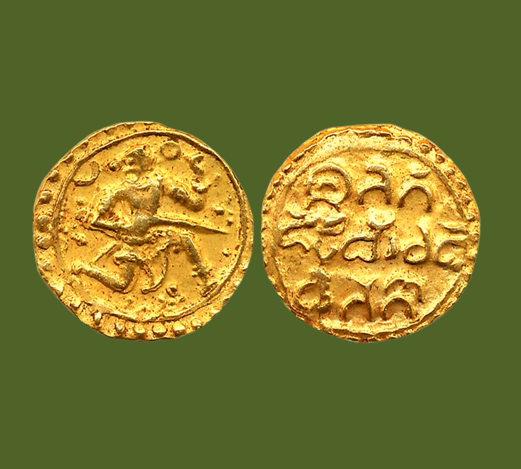
The use of royal titles is equally important. Titles could convey attributes such as military prowess, sovereignty, devotion or royal status. On rare feudatory issues, these titles may sometimes be more prominent than the ruler's personal name, making the study of epigraphy essential to their attribution. In image, gold Gadyana of Barma Bhupala, Torgal weighs 3.78 g. The obverse of the coin depicts a warror running to the right, holding a sword, with the Sun on the right above and Moon on the left above. The reverse features 3-line legends in Kannada, “Sri Nigalamkala Dam-dinagova”.
Celestial symbols such as these could express the enduring nature of royal authority—suggesting sovereignty that would endure as long as the Sun and Moon.
The terms Nigalamkalalla and Danginagova are understood as titles borne by the local ruler of Torgal, rather than simply being personal names. Their appearance on the coin demonstrates how titles could serve as an important expression of political identity in the medieval Deccan.
-
Rare Gold Lakshmi Coin of King Naravarman, Paramara of Malwa
2026-08-20 Thu -
Trident and Dagger on Sri Khengarji III’s Coin of Kutch
2026-08-19 Wed -
Copper 3 Dokdo of Nawanagar’s King Jam Sri Vibhaji II
2026-08-19 Wed -
Jai Hind – The Final Coinage of Kutch State
2026-08-18 Tue -
Nawanagar Silver 5 Kori of Jam Shri Vibhaji II
2026-08-18 Tue