
2026-08-12 Wed
In the Holkar state of Indore, Nazarana issues appear across several reigns, often featuring the dynasty’s distinctive sun-face emblem. The Mudra series of Tukoji Rao II represents one of the more innovative and short-lived experiments in this tradition. This series of coins show slight legend in Sanskrit phrases praising Tukoji with the blessings of Shiva, Malhar, and Ahilya.
We have already seen about Tukoji Rao II and Holkar state in our last article. You can read those articles below, Silver Nazarana Mudra of Tukoji Rao II, Holkar State.
His reign saw both traditional hand-struck coinage and experimental efforts at improved minting techniques under growing British pressure to standardize or curtail independent princely mints.
The term “Nazarana” derives from the Persian/Arabic root nazar or nazr, meaning an offering, gift, tribute, or presentation made in the presence of a superior. In Indian court tradition, reaching back through Mughal practice and continuing in the princely states—such coins were specially struck for ceremonial use rather than everyday circulation. They were typically larger in flan, heavier or better struck, often from full dies with complete legends visible, of superior workmanship, and presented on formal occasions as tokens of allegiance and respect.
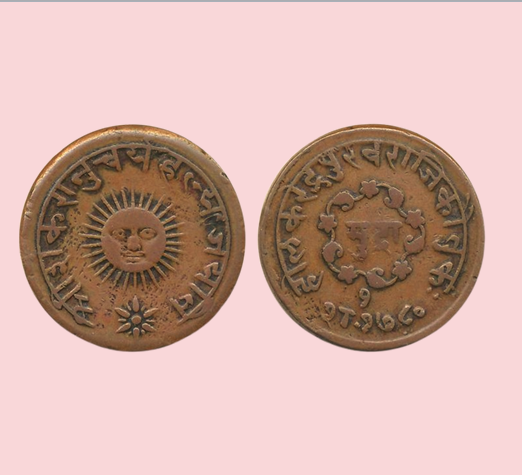
The obverse of the shown coin depicts a radiant sun face with Devanagari legend around, commonly rendered along the lines of “Shri Shankaranucharya Ahlya Jayati”. The reverse shows the legend “Mudra” prominently placed, often within a circle, wreath, or ornate border, surrounded by legend such as “Holkarendra Puravaraji Kautukah”. This coin weighs 8.80 g. It is dated (Saka Era) SE 1780 (1858 CE).
This copper Nazarana Mudra of Tukoji Rao II thus bridges tradition and transition: a prestige object rooted in centuries-old practices of nazar, struck at a moment when Indore was navigating the post-Mutiny landscape. Collectors and historians continue to value such pieces for the light they shed on both ceremonial culture and the practical challenges of coin production in 19th-century Central India.
-
Copper Nazarana Paisa of Jaipur: The Jhar-Marked Coinage of Sawai Jaipur
2026-08-12 Wed -
Rare Nazarana Rupee of the Holkar State, depicting King Jaswant Rao as a bee at the feet of Lord Vishnu
2026-08-11 Tue -
Silver Nazarana Mudra of Tukoji Rao II, Holkar State
2026-08-11 Tue -
Elegant Gold Mohur of Maharaja Pratap Singh, Baroda
2026-08-10 Mon -
Lakshman Singh’s Gold Nazarana Mohur of Dungarpur
2026-08-10 Mon