
2026-07-15 Wed
The Gupta Empire (c. 320–550 CE) was one of the most influential classical dynasties in Indian history, extending across large parts of northern, central, and portions of western and eastern India. This period is frequently described as a “Golden Age” due to significant progress in fields such as art, science, literature, philosophy, and governance.
The Guptas established enduring cultural and intellectual traditions that shaped not only the Indian subcontinent but also regions beyond, including parts of Southeast Asia. Evidence of their achievements comes from inscriptions, numismatic records, seals, and accounts of foreign travelers such as Faxian. Together, these sources provide valuable insights into the political, cultural, and economic life of the time.
Skandagupta (c. 455–467 CE) was among the last major and important rulers of the Gupta Empire. A major invasion of Huns happened during his time. There were skirmishes with Huns in North-West India. Shortly after ascending the throne a major invasion of Hepthalite Huns ravaged the North West India. Under the leadership of Skandagupta the invasion was decisively defeated and Huns could never recover from this defeat. Almost after 50 years Mihirkula tried his luck to invaded India and was properly shown his place by Yashodharman.
The coinage issued during his reign reflects both continuity and change. While the tradition of finely crafted gold dinars continued, their production shows decline in gold percentage in the coins, and due to this the fine style showed deteriration. These gold coins typically weigh between approximately 7.5 and 8.5 grams and include well-known types such as the Archer type, King-and-Lakshmi type, and Lion-slayer type.
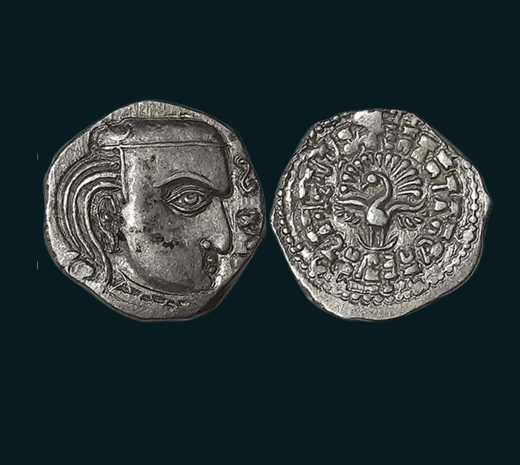
Skanda – as the name suggests is the name of warlord god Karthikeya. Peacock being the vahana of Lord Karthikeya, most of the Skanda’s issues from Madhyadesh carry fan tailed peacock in centre with all the feathers up. Other silver issues of Skandagupta depict many other motifs like Bull, a stylized Garuda, Altar, and rarely Bull by a Trishul in centre with Brahmi legend around.
The above silver, Peacock-Madhyadesha type Drachma weighs 2.41g. The obverse depicts profile bust of king and traces of Gupta Era date. The reverse features Fan-tailed peacock in center, Complete Brahmi legend starting 12 o’clock “Vijitavanir avanipati sri Skandagupto divam jayati” meaning Skandgupta, the conquerer of the world, lord of the earth triumphs.
-
The Elephant on an Indo-Greek Silver Drachm of Apollodotus I
2026-09-22 TueElephants were not just an important part of Indian heritage and religious traditions; they also ...
-
Gajalakshmi Flanked by Elephants on a Post-Mauryan Ujjaini Copper Coin
2026-09-22 TueThe association between Gajalakshmi and elephants is one of the most enduring motifs in Indian re...
-
Elephant Head on a Bronze Coin of Indo-Scythian King Maues
2026-09-21 MonAs the eighth day of Ganesh Utsav is celebrated, the elephant once again provides a fascinating l...
-
A Remarkable Elephant-and-Lion Standard on Vrishni Coinage
2026-09-21 MonAs Ganesh Utsav continues, the elephant once again offers a fascinating doorway into India’s an...
-
Elephant and Lion on a Cooch Behar Royal Coin
2026-09-19 SatThe elephant occupies a distinctive place in the cultural traditions of eastern India, particular...