
2026-07-08 Wed
King Sri Gupta circa 240–280 CE, founded the Gupta dynasty which lasted for next ~200 years and marked a golden chapter of Indian history. Two major events took place in the third century - fall of Kushan empire in North and disappearance of Satavahana in Deccan. Guptas capitalized on these events and built one of the strongest empires of India. Sri Gupta was followed by Ghatotkacha (c. 280–319 CE). These early rulers used the title Maharaja and laid the groundwork for expansion.
Chandragupta I (c. 319–335 CE) marked the empire's true beginning. He assumed the grander title Maharajadhiraja = great king of kings and expanded power through conquest and a strategic marriage alliance with the Licchavi clan via princess Kumaradevi. His reign started the Gupta Era (GE) calendar (c. 320 CE).
Samudragupta (c. 335–375/380 CE), son of Chandragupta I, was a brilliant military leader and a strategist. He was born ~1400 before Napoleon who can be loosely compared with Samudragupta for his achievements. His campaigns have been detailed in the Allahabad Pillar Inscription/Prashasti by Harisena. He subdued northern kings, southern rulers as far as the Pallavas, and frontier tribes. He expanded the empire across much of northern India while maintaining tributary relationships elsewhere. He was also a great patron of arts, music, and learning. There are must qualities any deserving noble king of India should possess.
To assert and claim his sway over India's main land Samudragupta performed Ashwamedha Yajna . This yajna was a grand Vedic ritual he performed to assert his imperial sovereignty and celebrate his extensive military conquests. This ancient Shrauta ritual symbolized a king's claim to universal dominion and grants him chakravartin status.
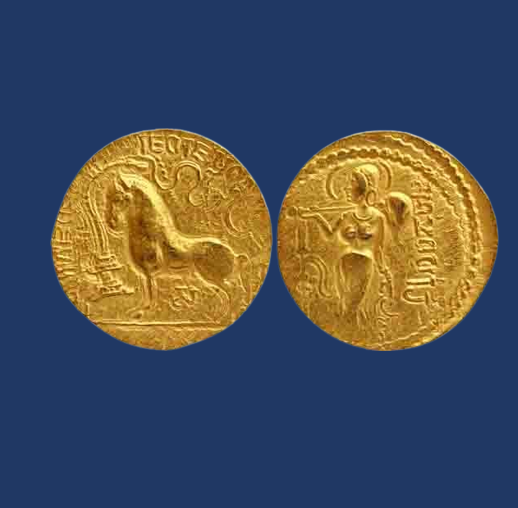
To commemorate this Yajna Samurdragupta minted gold Dinar with Horse standing to left by the Yupa and Brahmi legend rajadhiraja prithiviam...around and "si" between the legs denoting siddham. The reverse is depicted with the queen, standing left on lotus, holding chouri =fly whisk, and suchi = a filleted spear/large needle before her. Brahmi legend Shri Ashwamedha Parakrama on right side of the flan.
These dinars weigh around ~7.5 gram and carry high artistic merit. These exquisite, highly collectable coins feature specific iconographic and textual details unparalleled.
-
Anandas of Banavasi – Rano Visnu Rudra Buddhananda, Bull to Left Type
2026-11-11 WedLet us have a look at another fascinating coin from the Anandas of Banavasi, continuing our explo...
-
Striking Lead Coin of the Anandas of Banavasi
2026-11-11 WedThe Anandas of Banavasi represent an important chapter in the early historic coinage of Karnataka...
-
Rare Silver Dramma of Aparaditya, Shilaharas of North Konkan
2026-11-10 TueThe Shilaharas were an important ruling dynasty of western India, who governed different regions ...
-
Silver Dramma of Rashtrakuta King Amoghavarsha I
2026-11-10 TueThe Rashtrakutas were among the most powerful imperial dynasties of early medieval India, ruling ...
-
Goddess Lakshmi on a Gold Half Varaha of Harihara II, Vijayanagara Empire
2026-11-06 FriOn the auspicious occasion of Diwali, the festival of lights, prosperity and new beginnings, we c...