
2026-07-06 Mon
The Hoysalas of Dwarasamudra were a prominent South Indian dynasty that originated in the Malnad region of Karnataka. Initially serving as feudatories of the Western Chalukyas, they rose to power and ruled large parts of present-day Karnataka, along with portions of Tamil Nadu and Telangana, from around the 10th–11th century to the mid-14th century (c. 950–1346 CE).
Their primary capital was Dwarasamudra, the modern town of Halebidu ("old capital") in Hassan district, Karnataka. It became the main seat of power around 1062 CE and remained so until the end of the dynasty.The dynasty is traditionally believed to have been founded by Sala, with Nripa Kama II as its first historically significant ruler.
Among its illustrious kings were:
Vishnuvardhana (c. 1108–1152): One of the greatest Hoysala rulers. He defeated the Cholas, significantly expanded the kingdom, and promoted Vaishnavism.
Veera Ballala II (c. 1173–1220): Expanded Hoysala territories further and established the dynasty as a dominant power in southern India.
Veera Ballala III (c. 1292–1343): The last major ruler, who valiantly resisted invasions by the Delhi Sultanate for decades.
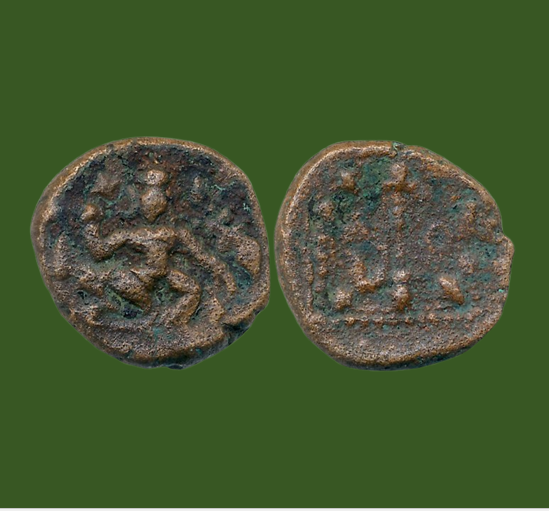
The Hoysalas are especially renowned for their distinctive Hoysala-style temple architecture, famous for its intricate soapstone carvings, star-shaped platforms, and exquisite sculptural details. Iconic examples include the Chennakeshava Temple at Belur, the Hoysaleswara Temple at Halebidu (Dwarasamudra), and the Kesava Temple at Somanathapura. They were strong patrons of Vaishnavism, as evidenced by coins featuring Lord Krishna in the atibhanga dancing pose on the coin above.
The reverse typically bore the royal Hoysala emblem. The dynasty primarily issued gold coins.
-
Exceptionally Rare Copper Dam of Gond King Gorakh Shah
2026-07-06 Mon -
Exceptional Legacy of Queens Named on Manikya Tanka
2026-06-29 Mon -
Rare Gold Tanka of Tripura King Rajadhara Manikya Featuring Queen Satyavati
2026-06-29 Mon -
Lion-Type Lead Coins of Western Kshatrapa King Nahapana Kshaharata
2026-06-26 Fri -
Conquest Coin of Satavahana- Gautamiputra Siri Satakani
2026-06-26 Fri