
2026-06-29 Mon
The Rajmala, the royal chronicle of the Tripura kings, traces the lineage of the rulers to the Lunar Dynasty of the Mahabharata, specifically through Druhyu, the son of Yayati. However, numismatic evidence suggests that the first historical Manikya ruler was, in fact, Maha Manikya, a Tripuri chief who founded the kingdom after establishing dominance over neighbouring tribes in the early 15th century. This monarch then adopted the title “Manikya” in honour of a significant victory over Bengal, and the name was subsequently inherited by his descendants.
The kingdom reached its zenith during the 15th–16th centuries, controlling vast territories including present-day Tripura, Assam’s Barak Valley, and parts of Bangladesh. Its domain is said to have extended to the Garo Hills in the north, the Bay of Bengal in the south, and Burma in the east.
The coinage of the Manikya dynasty or Tripura/Twipra Kingdom, forms a significant aspect of Northeast Indian numismatics. It began in the mid-15th century and continued into the 19th century, primarily in the form of silver tankas (or tankahs), along with some gold issues and later smaller denominations. These coins served as symbols of royal authority, instruments of political propaganda, and mediums of economic exchange, often issued to commemorate important events.
The first documented coin issues date to around 1464 CE (Saka Era 1386), consisting of silver tankas depicting a lion facing left. These early issues marked the dynasty’s assertion of sovereignty and show stylistic influence from Bengal coinage. Notably, some coins mention queens, which is a distinctive feature. Dhanya Manikya issued coins commemorating his victories, while Vijaya Manikya II is particularly known for his commemorative tankas. Amara Manikya and Rajadhara Manikya I continued the tradition of silver tankas with increasingly refined legends and symbols. Coins of Rajadhara Manikya I (CE1586–1600) are well-documented examples of royal iconography. He was a devout Vaishnavite and is credited with constructing a Vishnu temple in Udaipur.
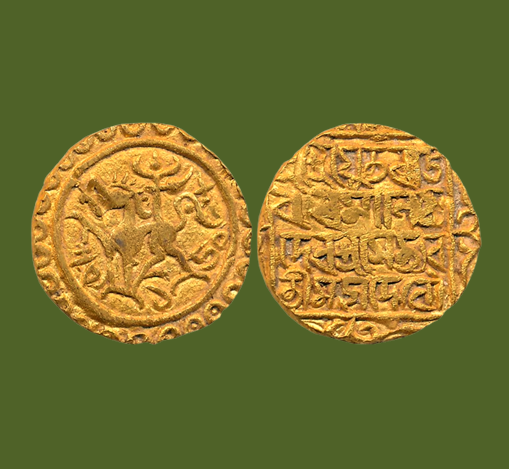
The gold tanka mentioned above, issued in the name of Queen Satyavati, weighs 10.67 g. The obverse depicts a lion facing left, with the date below. The reverse features a Sanskrit legend in Bengali script arranged in four lines: “Shri Shri Yuta Raja / Dhara Manikya / Deva Shri Satyava / ti Maha Devyau.” These are among the earliest known gold coins of Tripura.
-
The Elephant on an Indo-Greek Silver Drachm of Apollodotus I
2026-09-22 TueElephants were not just an important part of Indian heritage and religious traditions; they also ...
-
Gajalakshmi Flanked by Elephants on a Post-Mauryan Ujjaini Copper Coin
2026-09-22 TueThe association between Gajalakshmi and elephants is one of the most enduring motifs in Indian re...
-
Elephant Head on a Bronze Coin of Indo-Scythian King Maues
2026-09-21 MonAs the eighth day of Ganesh Utsav is celebrated, the elephant once again provides a fascinating l...
-
A Remarkable Elephant-and-Lion Standard on Vrishni Coinage
2026-09-21 MonAs Ganesh Utsav continues, the elephant once again offers a fascinating doorway into India’s an...
-
Elephant and Lion on a Cooch Behar Royal Coin
2026-09-19 SatThe elephant occupies a distinctive place in the cultural traditions of eastern India, particular...