
2026-06-26 Fri
The Satavahana dynasty, identified as the Andhras in the Puranas, was a major early historic power that ruled much of the Deccan region (present-day Maharashtra, Telangana, and Andhra Pradesh) from the late 2nd- 3rd century BCE. They played a vital role in connecting northern and southern India culturally and economically.
The dynasty’s founder, Simuka, is said to have overthrown the Kanva dynasty, though their exact origins remain debated. Based on archaeological and numismatic evidence, their rise likely began in the late 2nd or early 1st century BCE. The dynasty is believed to have had around 17–30 rulers.
Satavahana coinage was diverse and regionally significant. Lead coins were most common for public use, while copper and potin coins frequently featured motifs like the elephant and Ujjain symbol. Silver coins were rarer and often overstruck on Western Kshatrapa coins after victories, while gold coins were extremely scarce. Legends were inscribed in Brahmi script using Prakrit, typically reading “Rano Gotamiputasa Siri Satakanisa.” Most coins were round, though some were square or rectangular.
The greatest Satavahana ruler, Gautamiputra Satakarni (1st–2nd century CE), revived the dynasty after foreign invasions. His achievements are recorded in the Nashik Prashasti by his mother Gautami Balashri, which describes him as “Trisamudratoyapithavahana,” indicating vast territorial control. He is especially known for defeating the Kshaharata ruler Nahapana.
This victory is clearly reflected in coinage. Thousands of Nahapana’s silver coins found at Jogalthambi were overstruck by Gautamiputra, symbolizing both political dominance and economic control.
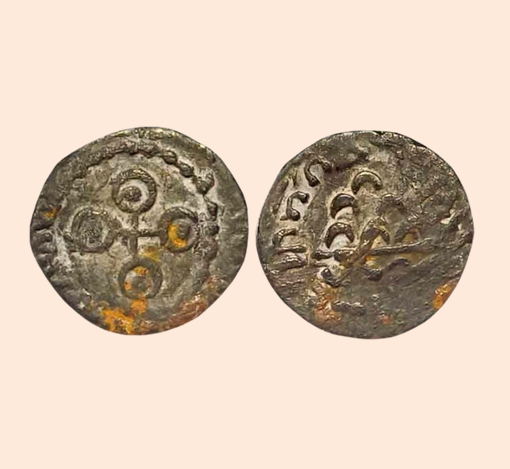
Here illustrated silver drachm weighs 2.15 g, where traces of Nahapana’s bust and Greco-Roman legend remain visible beneath Satavahana symbols of a three-arched hill with crescent and Brahmi legend “Rano Gota…”on the obverse. The reverse shows the Ujjain symbol, with faint remnants of earlier designs beneath.
These overstruck coins stand as powerful evidence of conquest and continuity, highlighting the Satavahanas’ ability to assert authority while adapting existing monetary systems. Their legacy remains central to understanding the political and economic history of ancient Deccan India.
As a part of Satavahana coin series, explore also- Lead Coin of Satavahana, Ruler Siri Satakarni.
-
The Elephant on an Indo-Greek Silver Drachm of Apollodotus I
2026-09-22 TueElephants were not just an important part of Indian heritage and religious traditions; they also ...
-
Gajalakshmi Flanked by Elephants on a Post-Mauryan Ujjaini Copper Coin
2026-09-22 TueThe association between Gajalakshmi and elephants is one of the most enduring motifs in Indian re...
-
Elephant Head on a Bronze Coin of Indo-Scythian King Maues
2026-09-21 MonAs the eighth day of Ganesh Utsav is celebrated, the elephant once again provides a fascinating l...
-
A Remarkable Elephant-and-Lion Standard on Vrishni Coinage
2026-09-21 MonAs Ganesh Utsav continues, the elephant once again offers a fascinating doorway into India’s an...
-
Elephant and Lion on a Cooch Behar Royal Coin
2026-09-19 SatThe elephant occupies a distinctive place in the cultural traditions of eastern India, particular...