
Greek And Roman Deities On Coins-11
2026-01-22 Thu
The #Greek god Pan is a distinctive figure within the extensive and varied #Pantheon of Greek tradition. He is revered as the deity of fertility, flocks, and the #wilderness of mountainous regions. Additionally, Pan is recognized as the patron of shepherds and huntsmen. His physical form is not entirely human; he possesses the legs of a #GOAT along with #horns emerging from his head. In Roman tradition, he is often equated with Faunus.Common belief holds that Pan is the offspring of #hermes, the god associated with travelers, trade, thieves, language, and writing, and a nymph. He was born bearing horns, a goat’s beard, a crooked nose, pointed ears, a tail, and goat-like feet. Due to his unusual appearance, his mother fled in distress. However, Hermes brought him to Olympus, where Pan's playful demeanor won him favor among the gods, particularly with Dionysus. To learn more about Dionysus, refer to the link below: Greek And Roman Deities On Coins-1
The gods named him ‘Pan,’ which translates to ‘all,’ in recognition of the joy he brought to them.
The worship of Pan is believed to have originated in the mountainous lands of Arcadia in the Peloponnese, Southern #Greece. By the early 5th Century BCE, veneration of Pan had spread to #Athens and other areas. Notably, his wild nature has the capacity to elicit "panic" in humans who encounter him unexpectedly in the wilderness. Consequently, the term "panic" is derived from his influence, particularly the fear incited by unfamiliar sounds in forested areas. #historical accounts suggest that during the Battle of #Marathon in 490 BCE, Athenians believed Pan favored them, instilling fear in the hearts of their #Persian enemies.
Depictions of Pan in Greek art can be traced back to around 500 BCE. In the earliest representations on pottery, Pan is depicted entirely as a goat, standing upright on his hind legs. Over time, later illustrations showcase him with a human upper body and head, complete with goat horns. Coinage from this period often portrays him as a man with a horned and beard, adorned with a tainia, a traditional headband.
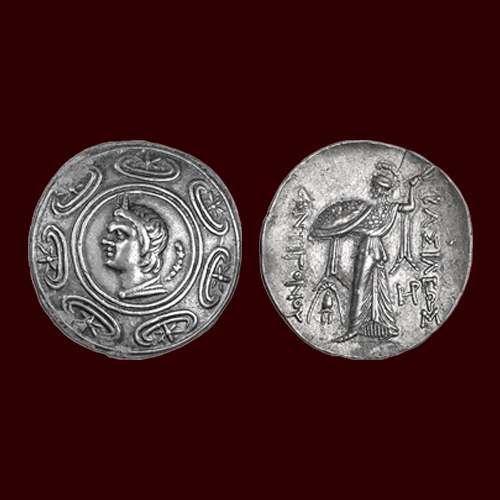
The #COIN featured in this post is a #silver Tetradrachm of Antigonus II Gonatas from Macedon, dating back to 277 BCE–239 BCE. Weighing 17.11 grams, the coin features on the obverse the horned head of Pan facing left, clad in goat skin around his neck and a pedum, a shepherd's staff, at the back. The head is surrounded by seven Macedonian shields.
The reverse features Athena Alkidemos (an epithet meaning defender of the people) holding a shield in her right hand and a thunderbolt in her left. A Macedonian helmet is depicted beneath her right hand, with a monogram below her left. The Greek inscription reads BASILEOS ANTIGONOU, translating to "of #king Antigonus."
To learn more about Athena, refer to the link below: Greek And Roman Deities On Coins-2
Latest News
-
Greek And Roman Deities On Coins-12
2026-01-22 ThuHermes is recognized as an Olympian deity in #ancient #Greek religion and is traditionally regarded...
-
A Gold Gadyana (3.78g) of Barma Bhupala of Torgale, a feudatory region under the Kalachuris of Kalyani, sold for INR 5,50,000
2026-01-21 WedGold Gadyana (3.78g) of Barma Bhupala, a powerful feudatory ruler of the Torgale region (located in ...
-
Greek And Roman Deities On Coins-10
2026-01-20 TueAphrodite, one of the most worshipped deities in ancient Greece, stands as the goddess of love, desi...
-
Greek And Roman Deities On Coins-9
2026-01-19 MonThe Greek goddess Nike holds a significant place in the ancient Greek world as a deity associated wi...
-
Greek And Roman Deities On Coins-8
2026-01-17 SatIn ancient Greek tradition, Artemis is revered as the goddess of nature, childbirth, wildlife, Heali...