
Greek And Roman Deities On Coins-4
2026-01-13 Tue
Aquatic creatures have consistently been a significant subject of human artistic expression, as seen in various forms of #art throughout #History, including numismatics. Notably, mythical sea creatures such as mermaids and mermen frequently appear in artistic representations across different cultures. In ancient #Greek and Roman art, mermen emerged as prominent figures, symbolizing the #Power, #MYSTERY, and dual #nature of the sea, which serves as both a source of life and a realm of #DANGER.In #GreekMythology, the most iconic merman is Triton. He is the son of #poseidon (one of the twelve Olympians presiding over the sea, storms, earthquakes and horses) and Amphitrite (Goddess of the sea). A God of the sea, Triton embodies significant #maritime #Authority. He is depicted with the upper body of a human and the lower body of a fish, frequently accompanied by a conch shell, a powerful instrument that allows him to summon stormy waters or calm the ocean’s #waves at will.
Triton has been featured on #Coins since 550 BCE, particularly on those from Cyzicus (or Kyzikos) and Itanus. To learn about Cyzicus, please refer to this link Greek And Roman Deities On Coins-2
. On the other hand, Itanus or Itanos was a Greek city and port on the northeast coast of ancient Crete, an island in the Mediterranean Sea.
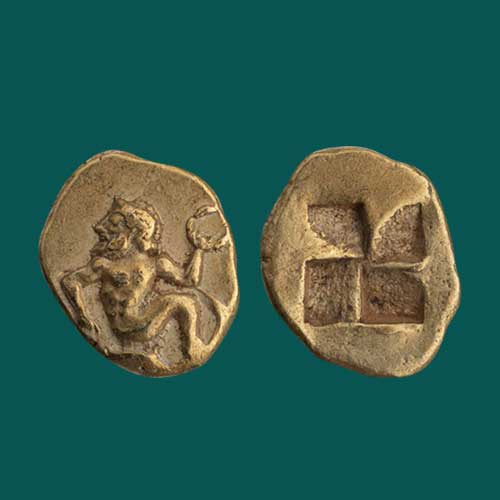
The #COIN featured in this post is an electrum Hekte from Cyzicus, showcasing Triton holding a wreath, with a tuna fish depicted below. The reverse showcases a swastika pattern / quadripartite incuse square.
Latest News
-
Greek And Roman Deities On Coins-3
2026-01-13 TueHerakles, also known as Hercules in Roman mythology, is one of the most celebrated heroes in Greek M...
-
Science and Technology on Indian Postage Stamps-32
2026-01-09 FriPrasanta Chandra Mahalanobis, widely regarded as the Father of Indian Statistics, was a distinguishe...
-
Greek And Roman Deities On Coins-2
2026-01-09 FriDeities have been worshipped in diverse forms throughout human History. Each religion has outlined s...
-
Science and Technology on Indian Postage Stamps-31
2026-01-09 FriThe Ooty Radio telescope (ORT), located in Muthorai near Ooty, Tamil Nadu, stands as one of the larg...
-
Malwa Sultan Mahmud Shah II's Silver Tanka
2026-01-07 WedMahmud Shah II was the last ruler of the #Khalji dynasty of the #Malwa #Sultanate, reigning from AH ...