
Science and Technology on Indian Postage Stamps-5
2025-11-11 Tue
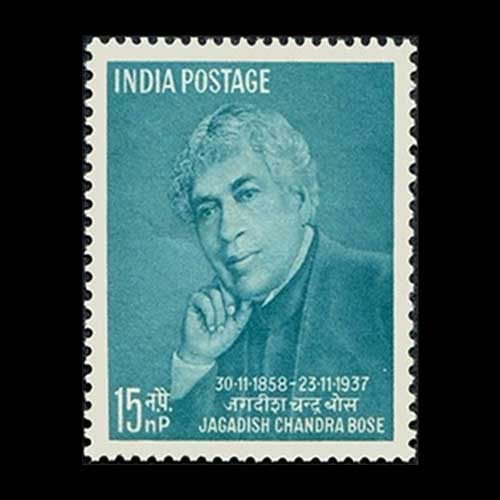
Sir Jagadish Chandra Bose recognized as India's first biophysicist was born on 30 November 1858, in Mymensingh, Bengal Presidency, which is now part of present-day Bangladesh. Influenced by his father's commitment to vernacular education, Bose developed an early passion for nature, fostering a profound connection that would significantly shape his scientific career. He initially enrolled at the University of London to pursue a medical degree but was compelled to withdraw due to health issues. Subsequently, he conducted research under the esteemed Nobel Laureate Lord Rayleigh at the University of Cambridge.In 1885, he accepted a position at Presidency College in Calcutta as its first Indian Professor of Physics. In pre-independent India, the contributions to the natural sciences by Indian researchers were exceedingly rare. Bose made substantial contributions in the field of radio waves in the microwave spectrum and was the first to implement semiconductor junctions for their detection. He demonstrated a method to utilize radio waves for communication, presenting his findings at the Royal Society in London in 1899. The same principle was used by Marconi to invent a two-way radio in 1901. Generally averse to the idea of patenting his inventions, Bose became the first Asian to obtain a U.S. patent (No. 755840) for a galena crystal radio wave detector in 1904.
In addition to his work in physics, Dr. Bose's enthusiasm for the natural world led him to pioneer studies in plant physiology. His invention of the Crescograph, a specialized device for measuring the growth rates of plants, allowed him to explore plant responses to stimuli, revealing that plants exhibit sensitivities akin to "feelings."
Bose's dedication to plant research culminated in the founding of the Bose Institute in Calcutta in 1917. This institution stands as Asia's first modern research center focused on interdisciplinary scientific inquiry, upholding a tradition of research excellence that has persisted for over a century. He was honored with a knighthood in 1917 and, in 1920, became a Fellow of the Royal Society, making him the first Indian to receive such recognition in the field of science.
Furthermore, in 1896, he authored ‘Niruddesher Kahini"’ (The Story of the Missing One), a short story that heralded the inception of Bengali science fiction, earning him the distinction of being the father of this genre.
To commemorate this illustrious figure, India Post issued a commemorative stamp in his honor on 30 November 1958, coinciding with his birth centenary.
Latest News
-
The Elephant on an Indo-Greek Silver Drachm of Apollodotus I
2026-09-22 TueElephants were not just an important part of Indian heritage and religious traditions; they also ...
-
Gajalakshmi Flanked by Elephants on a Post-Mauryan Ujjaini Copper Coin
2026-09-22 TueThe association between Gajalakshmi and elephants is one of the most enduring motifs in Indian re...
-
Elephant Head on a Bronze Coin of Indo-Scythian King Maues
2026-09-21 MonAs the eighth day of Ganesh Utsav is celebrated, the elephant once again provides a fascinating l...
-
A Remarkable Elephant-and-Lion Standard on Vrishni Coinage
2026-09-21 MonAs Ganesh Utsav continues, the elephant once again offers a fascinating doorway into India’s an...
-
Elephant and Lion on a Cooch Behar Royal Coin
2026-09-19 SatThe elephant occupies a distinctive place in the cultural traditions of eastern India, particular...