
Science and Technology on Indian Postage Stamps-2
2025-11-05 Wed
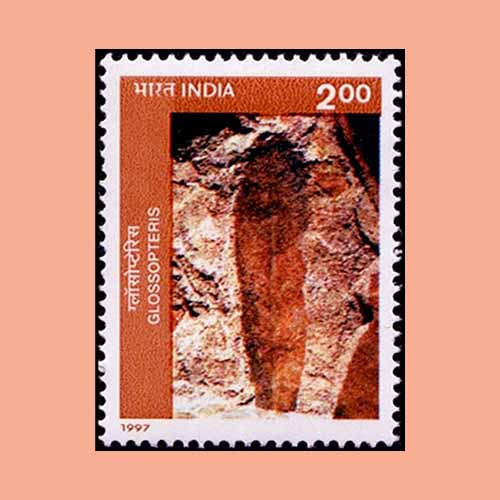
In continuation of the stamp series issued by India Post on 11 September 1997, to celebrate the 50th anniversary of the Birbal Sahni Institution of Palaeosciences (BSIP), another stamp features the fossil of a tongue-shaped leaf called Glossopteris. These fossils represent a unique group of extinct vascular plants from the Permian period, approximately 250-280 million years ago. During this era, the Indian subcontinent was situated south of the Equator, near the South Pole, as part of the extensive landmass known as Gondwanaland, which also included South America, Antarctica, Africa, and Australia. Notably, the vegetation dominated by Glossopteris played a significant role in the formation of coal reserves found in peninsular India.In 1920, the collaborative research of Albert Charles Seward and Professor Birbal Sahni, entitled ‘Indian Gondwana Plants: A Revision,’ marked a pivotal moment in the development of Indian geology and palaeobotany. In his research work, Professor Sahni has provided a comprehensive description of Glossopteris and delineated the differences between the flora of India and Australia in comparison to that of China and Sumatra.
Moreover, the BSIP is in the process of constructing a new building whose architectural design is inspired by the Glossopteris leaf, symbolizing the institute’s commitment to paleobotanical research. This development is taking place within its campus in Lucknow, Uttar Pradesh.
For further information regarding previous issue, please refer to Science and Technology on Indian Postage Stamps-1
Latest News
-
The Elephant on an Indo-Greek Silver Drachm of Apollodotus I
2026-09-22 TueElephants were not just an important part of Indian heritage and religious traditions; they also ...
-
Gajalakshmi Flanked by Elephants on a Post-Mauryan Ujjaini Copper Coin
2026-09-22 TueThe association between Gajalakshmi and elephants is one of the most enduring motifs in Indian re...
-
Elephant Head on a Bronze Coin of Indo-Scythian King Maues
2026-09-21 MonAs the eighth day of Ganesh Utsav is celebrated, the elephant once again provides a fascinating l...
-
A Remarkable Elephant-and-Lion Standard on Vrishni Coinage
2026-09-21 MonAs Ganesh Utsav continues, the elephant once again offers a fascinating doorway into India’s an...
-
Elephant and Lion on a Cooch Behar Royal Coin
2026-09-19 SatThe elephant occupies a distinctive place in the cultural traditions of eastern India, particular...