
Science and Technology on Indian Postage Stamps-1
2025-11-05 Wed
Palaeobotany is the scientific discipline dedicated to the study of fossilized plants and their historical development, aimed at reconstructing the evolution of the plant kingdom through the analysis of preserved plant remains within geological contexts. In India, palaeobotany is a well-established field significantly influenced by the contributions of Birbal Sahni, who is often referred to as the "Father of Indian Palaeobotany." Born on 14th November 1891 at Behra, a small town in Shahpur District (presently in Pakistan), he became the Professor of Botany at Lucknow University in 1921.Dr. Sahni’s ambition was to establish a systematic approach to palaeobotanical research in India. In 1929, he initiated this endeavor by founding a museum dedicated to plant fossils. By 1939, he had formed the committee of Indian Palaeobotanists, known as "The Palaeobotanical Society." His foresight ultimately led to the establishment of the Institute of Palaeobotany, which was later renamed the Birbal Sahni Institute of Palaeobotany in Lucknow, Uttar Pradesh.
Currently known as the Birbal Sahni Institute of Palaeosciences (BSIP), this institution operates as an autonomous entity under the Government of India's Department of Science and Technology. In 1951, the Birbal Sahni Institute of Palaeosciences was included in UNESCO's Technical Assistance Programme, further emphasizing its significance in the global scientific community.
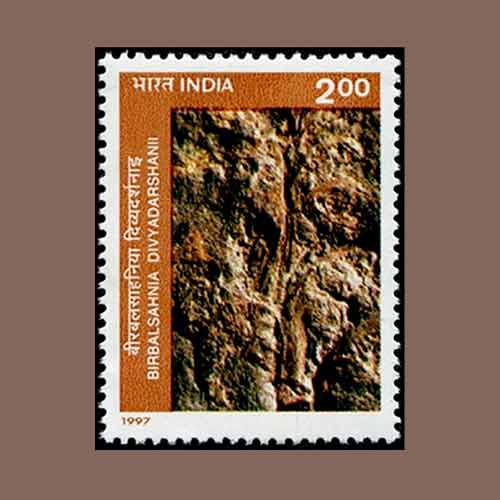
On 11 September 1997, India Post released a set of 4 stamps celebrating the 50th anniversary of the institution. Among these stamps, two feature plant fossils and two showcase fossil plant reconstructions. Notably, one stamp illustrates a fossil of a male reproductive organ from an extinct plant named Birbalsahnia divyadarshanii, for a face value of Rs 2. This nomenclature pays tribute to distinguished scholars—Professor Birbal Sahni and Professor Divya Darshan Pant, a globally recognized plant morphologist and palaeobotanist.
The fossil was discovered by Drs. H.K. Maheshwari and Usha Bajpai in the Hura Coalfield, located within the Rajmahal Coalfield of Jharkhand, dating back approximately 250 to 280 million years.
Image Courtesy: India Post
Latest News
-
The Elephant on an Indo-Greek Silver Drachm of Apollodotus I
2026-09-22 TueElephants were not just an important part of Indian heritage and religious traditions; they also ...
-
Gajalakshmi Flanked by Elephants on a Post-Mauryan Ujjaini Copper Coin
2026-09-22 TueThe association between Gajalakshmi and elephants is one of the most enduring motifs in Indian re...
-
Elephant Head on a Bronze Coin of Indo-Scythian King Maues
2026-09-21 MonAs the eighth day of Ganesh Utsav is celebrated, the elephant once again provides a fascinating l...
-
A Remarkable Elephant-and-Lion Standard on Vrishni Coinage
2026-09-21 MonAs Ganesh Utsav continues, the elephant once again offers a fascinating doorway into India’s an...
-
Elephant and Lion on a Cooch Behar Royal Coin
2026-09-19 SatThe elephant occupies a distinctive place in the cultural traditions of eastern India, particular...