
Fascinating Archaeological Facts on Postage Stamps - 74
2025-07-16 Wed
Brinjal, also referred to as eggplant or aubergine, is cultivated globally for its edible fruit, primarily utilized as a Vegetable in various culinary applications. Botanical research indicates that brinjal (Solanum melongena) is derived from wild, prickly, perennial ancestors, which have undergone continuous selection by humans for desirable traits such as reduced spines or Sharp points, diminished bitterness, and larger fruit size. As noted by Zeven and Zhukovsky (1975), the origins of brinjal can be traced back to #India, where it spread eastward by the 5th century BCE.In India, brinjal is extensively cultivated and is known by several names across different linguistic contexts, including Baingan (Hindi), Begun (Bengali), Ringna (Gujarati), Badane (Kannada), Vange (#Marathi), Vashuthana (#malayalam), Kathiri (Tamil), Vankaya (Telugu), etc.
The #historical culinary significance of brinjal in India can be traced back to the Harappan Civilization. In 2010, researchers from Washington State University Vancouver uncovered evidence of the world’s oldest known curry from Farmana (Haryana). Employing starch analysis, they examined samples from 50 distinct surfaces, such as pottery, tools and dental calculus, revealing traces of a curry that included aubergine, ginger, and turmeric.
Brinjal is also referenced in several significant literary works, including the epics Ramayana and Mahabharata. Its occurrences are recorded in #Jain and #Buddhist texts, such as the Uttaradhyayana Sutra, Prajnapana Sutra, and Jatakas, and it is featured in Sangam literature as well.
In "Antiquity of the Cultivation and Use of Brinjal in India" (2008), authors Bhat and Vasanthi reference various historical treatises that elaborate on brinjal preparations, including the Manasollasa by Kalyani Chalukya #King Someshvara III (12th Century CE), Lingapurana by Gurulinga Desika (1594 CE), and Shiva Tattva Ratnakara by King Basavaraja of Keladi in #Karnataka (1700 CE).
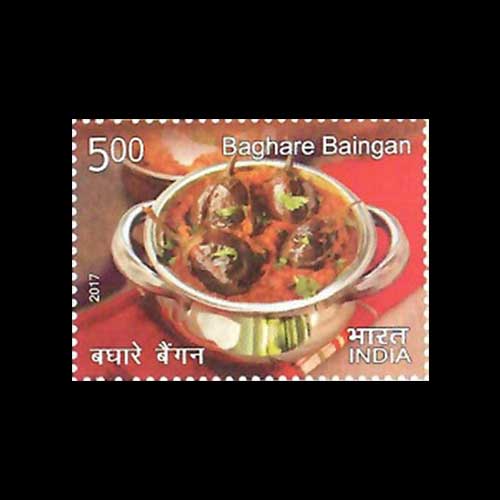
On 03 November 2017, India Post launched a set of 24 Stamps, accompanied by five miniature sheets, dedicated to #Indian cuisine. One of these stamps features Baghare Baingan, a renowned Hyderabadi brinjal curry celebrated for its rich, spicy, and tangy gravy, often served as a side #DISH with Hyderabadi biryani.
Latest News
-
The Elephant on an Indo-Greek Silver Drachm of Apollodotus I
2026-09-22 TueElephants were not just an important part of Indian heritage and religious traditions; they also ...
-
Gajalakshmi Flanked by Elephants on a Post-Mauryan Ujjaini Copper Coin
2026-09-22 TueThe association between Gajalakshmi and elephants is one of the most enduring motifs in Indian re...
-
Elephant Head on a Bronze Coin of Indo-Scythian King Maues
2026-09-21 MonAs the eighth day of Ganesh Utsav is celebrated, the elephant once again provides a fascinating l...
-
A Remarkable Elephant-and-Lion Standard on Vrishni Coinage
2026-09-21 MonAs Ganesh Utsav continues, the elephant once again offers a fascinating doorway into India’s an...
-
Elephant and Lion on a Cooch Behar Royal Coin
2026-09-19 SatThe elephant occupies a distinctive place in the cultural traditions of eastern India, particular...