
Fascinating Archaeological Facts on Postage Stamps - 73
2025-07-16 Wed
Laddoos is quintessential sweet in Indian culinary traditions. It is a delicacy found commonly in Indian households and most of the temples which distribute them as prasadam. Laddus are typically made of flour, ghee, and sugar, with remarkable #regional variations. But that’s not all. Laddoo can be made of many ingredients or single main ingredient. The Motichoor ladoo is believed to originate from #Rajasthan and Uttar Pradesh, while South India boasts the Coconut ladoo, Assam is known for its Til ladoo, and Maharashtra features the renowned dinkache ladoo—each variation possesses its unique identity. The Churma laddu of #Gujarat or Boondi laddu and besan laddu, famous all over India makes one drool.The history of laddoos can be traced back to the Harappan Civilization. In 2017, archaeologists uncovered seven multi-grain laddoos at the archaeological site of 4MSR or Binjor, located in western Rajasthan near the Pakistan border. These laddoos, dating to approximately 2600 BCE, were remarkably preserved due to a hard structure that had fallen over them, shielding them from damage. The primary ingredients in these ancient laddoos included moong dal, millet, cereals, and other legumes.
According to The Bloomsbury Handbook of Indian cuisine (2023), the term "laddoo" is derived from "ladduka" in Sanskrit and is mentioned in the Sushruta Samhita, describing small edible balls made from sesame seeds, jaggery, and PEANUTS, which are often coated with honey.
Moreover, an 11th-century encyclopedic work entitled Lokopakara (For the benefit of people), authored by Chavundaraya II in Old Kannada, also references laddoos. These were traditionally prepared by mixing vermicelli made from RICE flour, yogurt, ghee, and sugar syrup, with tamarind juice added for enhanced flavor.
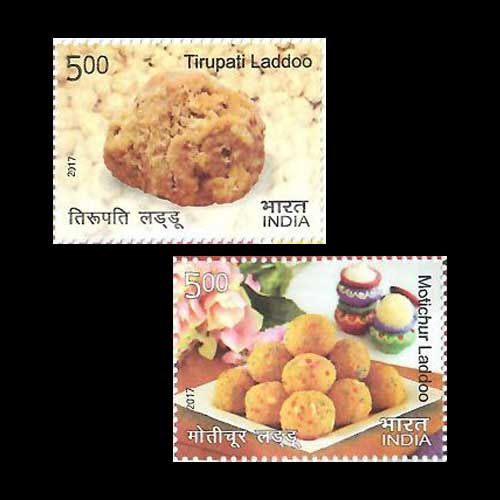
Besides, in India some Hindu temples offer their own version of laddoos as prasad. Popular among them are Tirupati Ladoo or Srivari laddu introduced in 1715.
On 03 November 2017, India Post issued a set of 24 Stamps along with 5 miniature sheets dedicated to Indian cuisine. Among these, two stamps featured the Tirupati Ladoo and the Motichoor Ladoo, each with a face value of Rs 5, highlighting the cultural significance of these delicacies.
Latest News
-
The Elephant on an Indo-Greek Silver Drachm of Apollodotus I
2026-09-22 TueElephants were not just an important part of Indian heritage and religious traditions; they also ...
-
Gajalakshmi Flanked by Elephants on a Post-Mauryan Ujjaini Copper Coin
2026-09-22 TueThe association between Gajalakshmi and elephants is one of the most enduring motifs in Indian re...
-
Elephant Head on a Bronze Coin of Indo-Scythian King Maues
2026-09-21 MonAs the eighth day of Ganesh Utsav is celebrated, the elephant once again provides a fascinating l...
-
A Remarkable Elephant-and-Lion Standard on Vrishni Coinage
2026-09-21 MonAs Ganesh Utsav continues, the elephant once again offers a fascinating doorway into India’s an...
-
Elephant and Lion on a Cooch Behar Royal Coin
2026-09-19 SatThe elephant occupies a distinctive place in the cultural traditions of eastern India, particular...