
Fascinating Archaeological Facts on Postage Stamps - 68
2025-07-09 Wed
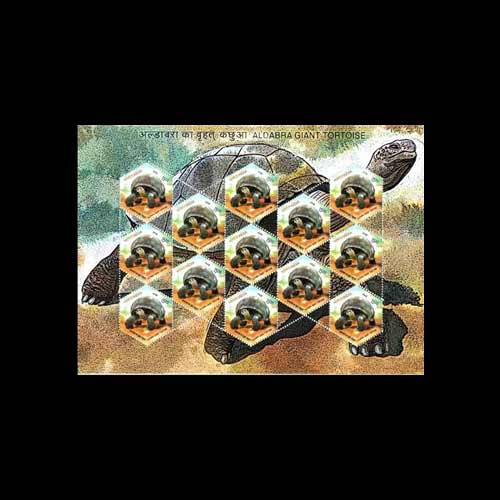
Tortoises are recognized as one of the oldest groups of reptiles, with a history dating back approximately 200 million years. They are also distinguished as the longest-living land animals in the world. Notably, an Aldabra giant tortoise named Adwaita featured on the stamp, which resided at the Zoological Garden, Alipore (#Kolkata), is believed to have lived for 255 years before passing away in 2006.In #India, tortoises carry significant cultural and ecological importance. Archaeological evidence of tortoises, including broken carapace pieces and #Bones, has been discovered at various sites across the country. These findings span different periods, including the Mesolithic, Neolithic, Chalcolithic/Harrapan, #IRON Age, and Early Historic Eras.
A fossil of a gigantic tortoise, currently housed at the Panjab #university, was found in the Shivalik Hills. Mesolithic rock paintings at Kerwa Ghat in Mirzapur (Uttar Pradesh) illustrate scenes of fish and tortoise hunted from a boat, indicating that tortoise flesh was used as food. Terracotta sculptures of tortoises have been unearthed at Harappa, and animal remains from late Harappan levels at Daulatpur near Kurukshetra (Haryana) include a piece of charred tortoise #Shell, suggesting the roasting for food. Excavations at Maheshwar (Madhya Pradesh) revealed a fragment of a terracotta tortoise from the Mauryan level, while Ujjain (MP) yielded some terracotta figurines of tortoises from the Shunga period. Numerous early historic sites, such as Bhokardan (#Maharashtra), Kaushambi (Uttar Pradesh), Rajghat (UP), Taxila (presently in #Pakistan), Ter (Maharashtra), and Ujjain, have produced excavated tortoise shaped beads. A broken Clay figurine of a tortoise from the Satavahana period was also discovered at Nevasa in Maharashtra.
According to Devendra Handa, the Vishnudharmottara and the Agni #puranas mention that the tortoise serves as the vehicle of the River yamuna. Numerous sculptures depicting Yamuna on a tortoise have been uncovered in temples across India, with this representation becoming popular during the Gupta period. The Kurmavatar, a form of #Lord Vishnu, was when he took on the form of a tortoise to support #mount Mandar during the Samudra Manthan (churning of the ocean). MP Shete, in her research paper Kurma (tortoise) in Indian culture (2023), references that this depiction can be found in various locations throughout India as well as at Angkor Wat in #Cambodia.
Tortoises have also been depicted on coins. Handa notes that the earliest representation of a tortoise appears on half-karshapana Silver coins from the Asmaka Janapada. They are also featured on Punch-marked coins from Imperial Magadha and uninscribed copper coins from Ujjain, as well as on Pandyan coins and a lead coin found from Tripuri (Madhya Pradesh).
On 02 Aug 2008, India Post issued a two-hexagonal postage Stamps, accompanied by a full sheet, in honor of the Kolkata Zoo's Aldabra giant tortoise, Adwaita. Originally from the Aldabra Atoll in the Seychelles Islands, Adwaita was brought to India by British sailors in 1857.
Latest News
-
Uttama Chola’s Rare Kahavanu Carries a Tiger beneath the Parasol
2026-08-26 Wed -
A Gangaikonda Series Coin Celebrating Rajendra Chola’s Northern Conquest
2026-08-26 Wed -
Gold Puvitta Anantha Varahan of Travancore Queen Rani Gouri Lakshmi Bayi
2026-08-25 Tue -
A Musician and Composer King's Copper Kasu
2026-08-25 Tue -
Golden “Jaya Chola” on Fanam in Nandinagari Script
2026-08-24 Mon