
Fascinating Archaeological Facts on Postage Stamps - 67
2025-07-08 Tue
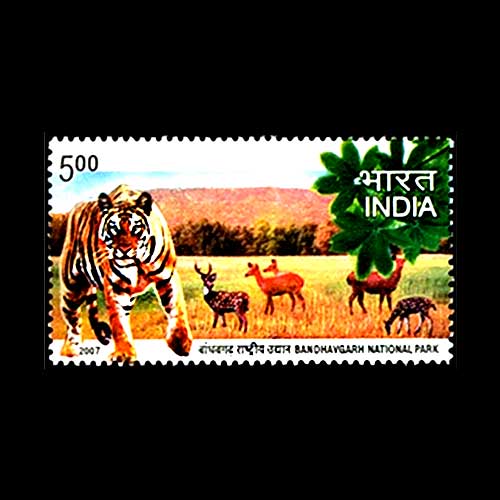
Bandhavgarh National Park, located in the Umaria district of Madhya Pradesh, is recognized not only as a prominent tiger reserve but also as a significant archaeological Site.Since the 2nd century CE, Bandhavgarh has served as an important hub for trade and commerce under the Magha dynasty of Kausambi (Uttar Pradesh). This dynasty emerged during the decline of the Kushan #Empire and the rise of the Gupta Empire. The region's dense forests and its strategic location along an #ancient trade route have greatly contributed to its historical importance. Continuous habitation throughout history has been evidenced by archaeological finds in this region.
In 1938, archaeologist Dr. N.P. Chakravarti conducted a comprehensive survey of the Bandhavgarh caves, with a focus on epigraphic documentation. Numerous inscriptions revealing the names of Magha kings and merchants were uncovered, suggesting that these merchants made religious endowments. A total of 24 inscriptions in Brahmi script, primarily in Prakrit with three in Sanskrit, were identified.
Recent findings from 2022-2023 by the Archaeological Survey of India (ASI) have revealed over 100 remains dating from the 2nd century to the 15th century within the core area of the Bandhavgarh Tiger Reserve. These findings include 26 caves from the 2nd century CE to the 5th century CE, predominantly associated with Mahayana #Buddhism, raising the total number of known caves in Bandhavgarh to 76. Noteworthy discoveries include Buddhist #structures such as pillars and two votive stupas.
Additionally, the ASI team discovered 24 inscriptions in Brahmi script, all dating back to the 2nd to 5th centuries CE. These inscriptions refer to various sites, including Mathura, Kaushambi, Pavata, Vejabharada, and Sapatanaairikaa, as well as to prominent kings such as Bhimsena, Pothasiri, and Bhattadeva.
Further excavations have yielded remains from the Gupta period, including door jambs, featuring characteristic Gupta carvings from the 4th to 5th century CE. The discovery of 26 temples from the Kalachuri period (9th to 11th centuries) and the world's largest Varaha sculpture from this period have also been documented, along with two Saiva mutts.
In 2024, researchers from Ashoka university identified microlithic assemblage in various locations within and around Bandhavgarh, indicating the potential for human habitation during the Upper or Middle Paleolithic period.
On May 31, 2007, India post issued a series of five stamps entitled "National Parks of India," one of which featured Bandhavgarh National Park valued at Rs. 5.
Latest News
-
The Elephant on an Indo-Greek Silver Drachm of Apollodotus I
2026-09-22 TueElephants were not just an important part of Indian heritage and religious traditions; they also ...
-
Gajalakshmi Flanked by Elephants on a Post-Mauryan Ujjaini Copper Coin
2026-09-22 TueThe association between Gajalakshmi and elephants is one of the most enduring motifs in Indian re...
-
Elephant Head on a Bronze Coin of Indo-Scythian King Maues
2026-09-21 MonAs the eighth day of Ganesh Utsav is celebrated, the elephant once again provides a fascinating l...
-
A Remarkable Elephant-and-Lion Standard on Vrishni Coinage
2026-09-21 MonAs Ganesh Utsav continues, the elephant once again offers a fascinating doorway into India’s an...
-
Elephant and Lion on a Cooch Behar Royal Coin
2026-09-19 SatThe elephant occupies a distinctive place in the cultural traditions of eastern India, particular...