
Fascinating Archaeological Facts on Postage Stamps - 66
2025-07-08 Tue
The Indian treatise on Shilpa SHASTRA has a special section on Murti / Pratima. It considers sculpture as sacred works of art, primarily in the form of statue.Indian sculptural art has honored LORD Buddha that reflects not only exceptional artistic skill but also profound philosophical insight and spiritual devotion. The representation of the Buddha in sculpture has evolved over time, capturing significant cultural transitions from the Mauryan period to the vibrant depictions found in later #medieval and contemporary art.
During Gupta Era, the sculptures of Buddha became notable for their serene and idealized representations, which emphasize transcendental wisdom and spiritual elegance. These works are characterized by a realistic style, soft and rounded forms, and gentle facial expressions that demonstrate a deep understanding of human anatomy and emotional complexity. Common features in these sculptures include the usnisa, or topknot on the head, which symbolizes the Buddha's #spiritualwisdom. The elongated earlobes represented his #royal #Lineage and detachment from material #wealth; and the urna, the mark between the eyebrows, indicated his third eye of insight. The intricately detailed robes are arranged in folds, enhanced the figure’s sense of movement and fluidity.
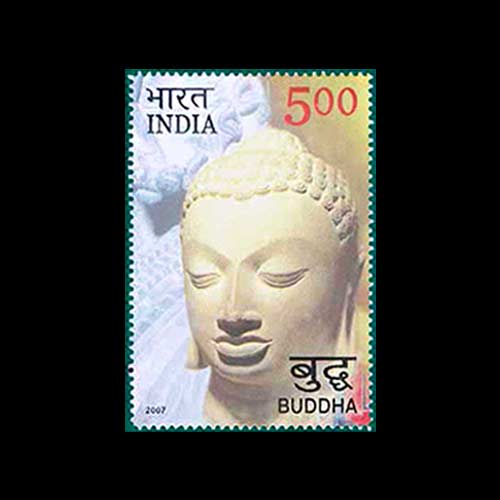
On 02 May 2007, India Post issued a set of six Stamps, along with miniature sheets, to commemorate the 2550th anniversary of the Mahaparinirvana of the Buddha. Among these is a stamp featuring the Buddha’s head from Sarnath (Uttar Pradesh) for a face value of Rs 5. This depiction presents the Buddha in the 'Dhyana mudra', characterized by downcast #eyes and a calm expression, symbolizing introspection and inner #Peace. Crafted from soft buff Chunar sandstone during the Gupta period, specifically between 500 CE and 600 CE, this sculpture is currently housed at the National Museum in #Delhi.
For further information regarding this series, please refer to This Postand This Post
Latest News
-
Uttama Chola’s Rare Kahavanu Carries a Tiger beneath the Parasol
2026-08-26 Wed -
A Gangaikonda Series Coin Celebrating Rajendra Chola’s Northern Conquest
2026-08-26 Wed -
Gold Puvitta Anantha Varahan of Travancore Queen Rani Gouri Lakshmi Bayi
2026-08-25 Tue -
A Musician and Composer King's Copper Kasu
2026-08-25 Tue -
Golden “Jaya Chola” on Fanam in Nandinagari Script
2026-08-24 Mon