
Fascinating Archaeological Facts on Postage Stamps - 64
2025-07-07 Mon
Ancient India's Gandhara included the historic city of Taxila and the Swat Valley, located in present-day Peshawar, Pakistan. During the early centuries of the COMMON Era, the distinctive Gandhara school of art encouraged creation of thousands of sculptures. These works were crafted from local stone, known as schist or phyllite, as well as molded in clay or stucco.The sculptural art from this period, including both reliefs and freestanding PIECES, primarily served to express the Buddhist faith, showcasing a distinctive amalgamation of stylistic influences from Hellenistic, persian, and Kushan cultures.
This artistic Gandhara School of Art movement, primarily focused on the representations of Lord Buddha, Bodhisattvas, and associated figures, closely aligned with Mahayana #Buddhism . It thrived under both direct and indirect patronage from the Kushan court in the late 3rd century CE and continued until the 6th century CE. Some of the earliest anthropomorphic depictions of the Buddha can be found on the Bimaran reliquary, dating back to the late first century CE. This small, intricately carved gold casket was excavated in the 1830s at Bimaran, located in present-day Afghanistan, which formed part of ancient Gandhara.
In these representations, the Buddha is typically portrayed as youthful and physically beautiful, without the symbols of #wealth or worldly significance. Earlier depictions occasionally include a moustache, though this feature becomes increasingly rare over time.
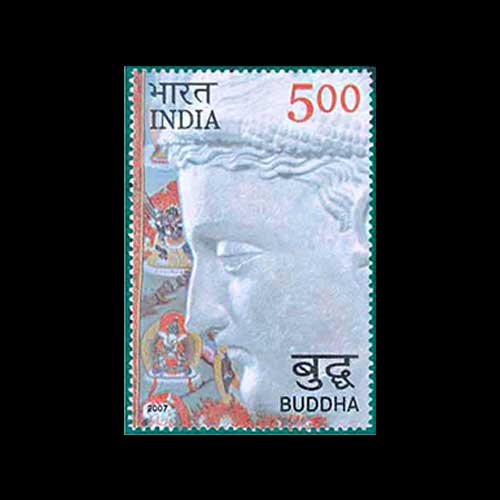
The representation of his life prior to enlightenment is also depicted through sculptures in Gandhara Art. The given stamp features a statue of Prince Siddhartha Gautama, with a face value of Rs 5. Additionally, Gandharan sculptures depict a diverse array of #buddhas , including the seven Buddhas of the past, Dipankara, and the future Buddha, Maitreya.
On 02 May 2007, India Post released a set of six #Stamps along with a miniature sheet to commemorate the 2550th anniversary of the Mahaparinirvana of Buddha.
Latest News
-
Uttama Chola’s Rare Kahavanu Carries a Tiger beneath the Parasol
2026-08-26 Wed -
A Gangaikonda Series Coin Celebrating Rajendra Chola’s Northern Conquest
2026-08-26 Wed -
Gold Puvitta Anantha Varahan of Travancore Queen Rani Gouri Lakshmi Bayi
2026-08-25 Tue -
A Musician and Composer King's Copper Kasu
2026-08-25 Tue -
Golden “Jaya Chola” on Fanam in Nandinagari Script
2026-08-24 Mon