
Fascinating Archaeological Facts on Postage Stamps - 56
2025-06-27 Fri
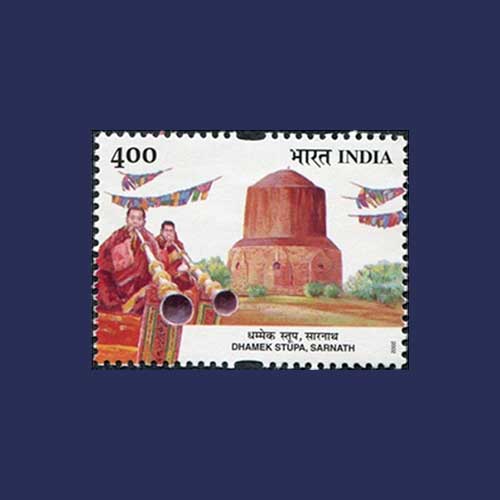
The Dhamek Stupa, situated in deer Park at Sarnath, Uttar Pradesh, is recognized as one of the eight most significant pilgrimage sites for Buddhists. This stupa commemorates the location where the LORD Buddha delivered his first sermon, known as the Dhammacakkappavattana Sutta, or the "Turning of the Wheel of Dharma," to his initial five disciples: Kaundinya, Assaji, Bhaddiya, Vappa, and Mahanama. Interestingly, an 11th century inscription recovered from the site indicates that the stupa was originally named as the Dharma Chakra Stupa.The existing structure was built in 500 CE to replace an earlier edifice established by Emperor ashoka in 249 BCE. Over the centuries, the stupa has undergone six notable expansions. It is in cylindrical shape, with layers of #Stone meticulously bonded using IRON clamps. The stupa boasts a base diameter of 28 meters and reaches a height of 43.6 meters, exemplifying a harmonious blend of stone and #brick construction.
Located halfway up the base are eight niches that likely accommodated images. Beneath these niches, there is a wide band of intricate carvings that incorporate geometric and floral motifs, as well as depictions of birds and #human figures. These carvings resonate with the designs of the original cloth covering, referred to as devadushya or #Divine garment," which was offered to envelop the entire stupa. This covering is considered a remarkable representation of extensive surface decoration and illustrates the exceptional craftsmanship of Gupta artisans in creating the most intricate scroll patterns.
In the year 1815, Colonel Mackenzie, followed by Alexander Cunningham conducted excavations at Sarnath, revealing invaluable treasures, including the Dhamek Stupa. During his search for a relic casket, Cunningham drilled a vertical shaft through the center of the stupa down to the foundation level. He uncovered a slab inscribed with the phrase "ye dharma hetu prabhava hetu..." in Brahmi script dating from the 6th to 7th century CE. Archaeological assessments suggest that this slab was inserted into the stupa at a later date.
During 1851-52, major Kittoe uncovered numerous votive stupas and shrines surrounding the Dhamek Stupa, as well as a large quadrangle, which he designated as a hospital, located to the west of the stupa.
Both Cunningham and Kittoe recovered and retrieved a significant collection of statues, stone umbrellas, inscriptions, bas-reliefs, and various sculptural panels from excavations and explorations.
On January 21, 2002, India post issued a series of four #Stamps in honor of Bauddha Mahotsav, one of which featured the Dhamek Stupa with a face value of Rs. 4.
Latest News
-
The Elephant on an Indo-Greek Silver Drachm of Apollodotus I
2026-09-22 TueElephants were not just an important part of Indian heritage and religious traditions; they also ...
-
Gajalakshmi Flanked by Elephants on a Post-Mauryan Ujjaini Copper Coin
2026-09-22 TueThe association between Gajalakshmi and elephants is one of the most enduring motifs in Indian re...
-
Elephant Head on a Bronze Coin of Indo-Scythian King Maues
2026-09-21 MonAs the eighth day of Ganesh Utsav is celebrated, the elephant once again provides a fascinating l...
-
A Remarkable Elephant-and-Lion Standard on Vrishni Coinage
2026-09-21 MonAs Ganesh Utsav continues, the elephant once again offers a fascinating doorway into India’s an...
-
Elephant and Lion on a Cooch Behar Royal Coin
2026-09-19 SatThe elephant occupies a distinctive place in the cultural traditions of eastern India, particular...