
Fascinating Archaeological Facts on Postage Stamps - 55
2025-06-26 Thu
Jewellery is one of humanity's oldest forms of artistic expression and adornment. Throughout History, people have often been buried with their most cherished belongings, particularly jewellery. Notably, a considerable number of Bone ornaments, including rings, pendants, and beads, have been uncovered in Mesolithic burials at sites such as Sarai Nahar Rai, Mahadaha, and Damdama in Uttar Pradesh.From ancient times, Indian artisans have been recognized for their exceptional craftsmanship in creating exquisite jewellery pieces. Various historical sculptures indicate that both men and women wore necklaces as part of their adornment. The discovery of ornaments at multiple Harappan sites further highlights the advanced skills of Indian craftsmen during primitive periods. For additional insights, please refer to This Post
References to ornaments can also be found in ancient literary texts. The Rig Veda, for instance, mentions terms like "Ratna" and "mani," which pertain to gems and jewels. Furthermore, names for various ornaments include Shipra, rukma, khadi, nishka, and sraj. Notable historians such as Megasthenes and Arrian have documented the significance of jewellery making in India. Additionally, Panini's work, the Ashtadhyayi, lists various jewellery items, including anguliya (finger rings), karnika (earrings), lalatika (forehead ornaments), graiveyaka (torques), and Kumba (female hair decorations).
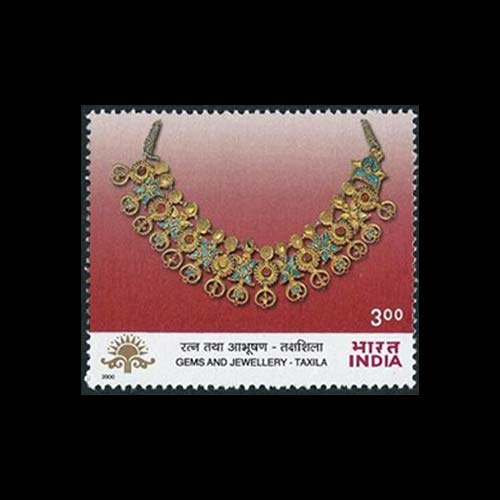
The second #stamp from the 'Gems & Jewellery' series, issued by India Post on 07 December 2000, features a necklace from Sirkap, #Taxila (presently in #Pakistan), dating back to the 1st Century CE. It was unearthed by John Marshall during the excavation between 1913 and 1930 and is currently housed in the National Museum.
The necklace is crafted from #gold and comprises 15 pendants with alternating designs, as well as an end piece. One pendant presents a flat disc set with a garnet at its center, surrounded by a beaded rim, and is adorned with a heart-shaped attachment featuring a cluster of granules.
Each of the remaining pendants showcases a turquoise Stone encased within a Diamond outline, surrounded by four leaf motifs set with turquoise and topped with a plain gold bead. The heart-shaped attachment below is designed with a heart-shaped turquoise. The end piece on one side features two leaves set with turquoise and two Lapislazuli stones in a #Drops-shaped arrangement, finished with gold beads.
The filigree and granulation techniques from Taxila are esteemed for their intricate and refined designs, especially in jewellery and decorative objects. The filigree method involves the meticulous crafting of fine #metal wire into ornamental patterns, exemplifying the high level of artistry and skill that characterizes this important #CulturalHeritage .
Latest News
-
The Elephant on an Indo-Greek Silver Drachm of Apollodotus I
2026-09-22 TueElephants were not just an important part of Indian heritage and religious traditions; they also ...
-
Gajalakshmi Flanked by Elephants on a Post-Mauryan Ujjaini Copper Coin
2026-09-22 TueThe association between Gajalakshmi and elephants is one of the most enduring motifs in Indian re...
-
Elephant Head on a Bronze Coin of Indo-Scythian King Maues
2026-09-21 MonAs the eighth day of Ganesh Utsav is celebrated, the elephant once again provides a fascinating l...
-
A Remarkable Elephant-and-Lion Standard on Vrishni Coinage
2026-09-21 MonAs Ganesh Utsav continues, the elephant once again offers a fascinating doorway into India’s an...
-
Elephant and Lion on a Cooch Behar Royal Coin
2026-09-19 SatThe elephant occupies a distinctive place in the cultural traditions of eastern India, particular...