
Fascinating Archaeological Facts on Postage Stamps - 24
2025-05-09 Fri
AjantaCaves, situated in the Chhatrapati Sambhaji nagar district (formerly #Aurangabad) of Maharashtra, are esteemed as a UNESCO World Heritage site. These caves were carved from rock over a period of 800 years (between 2nd century BCE and the 6th century CE). Majority of the work occurred in two phases: 2nd century BCE to 1st century CE under the #Satavahana dynasty and from 5th to 6th century CE under the #Vakataka dynasty.The caves were carved into a horseshoe-shaped cliff along the Waghora River and were meant to be used as Buddhist monastic complexes and worship sites. These caves are renowned for their intricate rock-cut architecture, sculptures, and vibrant murals depicting Jataka tales and scenes of daily life. The artworks were created to inspire common people and educated about Buddhist teachings. It also showcased the patronage of rulers and wealthy merchants.
The murals represent some of the most exquisite surviving examples of ancient Indian art. The artists employed a meticulous technique known as tempera, which entails mixing pigments with a binding agent such as glue or Egg yolk. This method has contributed to the vibrant colors of the murals, which have remarkably retained their brilliance over the centuries.
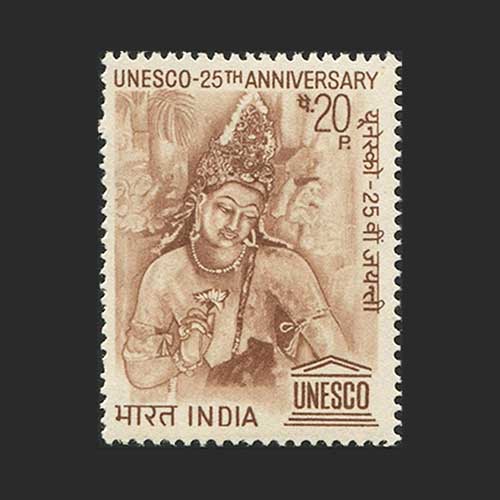
A particularly noteworthy artwork featured on this commemorative stamp is the 2200-year-old depiction of Bodhisattva Padmapani, also referred to as Avalokitesvara, located in Ajanta Cave No 1 (for more information on Bodhisattva or Avalokitesvara refer to This Post). The Bodhisattva Padmapani, often referred to as the lotus-bearer, is a distinguished representation of Avalokiteshvara, who embodies the essence of compassion in Buddhist philosophy.
The United Nations Educational, Scientific and Cultural Organization (UNESCO) was established on November 16, 1945, as a specialized agency of the United Nations (UN) committed to promoting world Peace through international cooperation in Education, art, sciences, and culture. In India, UNESCO has been actively engaged in initiatives aimed at preserving the tangible and intangible heritage.
In 1971, UNESCO marked its 25th anniversary. India, as a founding member of UNESCO, participated actively in the GLOBAL Celebrations of this important milestone. On November 4, 1971, India Post issued a stamp featuring the image of Padmapani from Ajanta, along with the UNESCO logo, with a face #value of 20 paise.
Latest News
-
An Interesting Five-Symbols on Punch-Marked Copper Square Karshapana of Eran
2026-11-18 WedThe ancient region of Eran, situated in present-day Madhya Pradesh, was an important centre of ea...
-
Sacred Symbols and Natural Motifs on Post-Mauryan Coinage of the Eran-Vidisha Region
2026-11-18 WedThe decline of the Mauryan Empire in the second century BCE marked the emergence of several regio...
-
Mithuna (Couple) Type Coin from the Post-Mauryan Ujjaini Region
2026-11-17 TueContinuing our exploration of the distinctive coinage of the Post-Mauryan Ujjaini region, let us ...
-
Lord Shiva Standing Type Copper Coin of the Ujjaini Region from Post-Mauryan Period
2026-11-17 TueThe Post-Mauryan period (200 BCE–300 CE) witnessed the emergence of several regional kingdoms, ...
-
Rare Silver 1½ Shana Punch-Marked Coin of Panchala Janapada
2026-11-16 MonThe Panchala Janapada was one of the sixteen Mahajanapadas of ancient India, flourishing during t...