
Nanda Punch Marked Coins
2020-09-16 Wed
Punch Marked coins are the earliest coins issued in India. Dating to between about the 6th and 2nd centuries BCE, these coins are a fascinating yet mysterious part of the Indian Coinage. As the name suggests, the coins are metal sheets with symbols punched on them. The punch-marked coins care called as Karshapanas or Pana in Puranas.The study of the relative chronology of these coins has successfully established that the first punch-marked coins initially only had one or two punches, with the number of punches increasing over time. Several of these coins had a single symbol, for example, Saurashtra had a humped bull, and Dakshin Panchala had a Swastika, others, like Magadha, had several symbols.
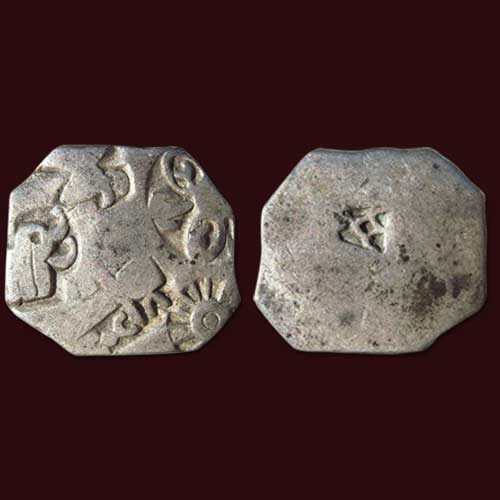
The above coin is a Punch Marked Coin of the Nanda Dynasty of Magadha. Magadha's earliest coins were dumpy silver 35-mashaka pieces of roughly 7.6 gm. that featured a single "6-arm symbol" punch. Around 420 BCE, the 25-mashaka denomination was replaced by a karshapana standard of roughly 3.5 gm. At first, the karshpanas continued to feature four punches, but quite soon this was changed to a five punch design.
The five symbols on this coin are the Sun symbol, six-armed (Magadha) symbol, a bull on a hilltop, Indradhvaja flanked by four taurines, elephant. The obverse is plain with a single punch of three-arched hill topped by a crescent.
Image Courtesy: wikiwand.com
Latest News
-
Rare Gold Gadyana of Barma Bhupala of Torgal: Local Power in the Kalachuri Deccan
2026-08-20 Thu -
Rare Gold Lakshmi Coin of King Naravarman, Paramara of Malwa
2026-08-20 Thu -
Trident and Dagger on Sri Khengarji III’s Coin of Kutch
2026-08-19 Wed -
Copper 3 Dokdo of Nawanagar’s King Jam Sri Vibhaji II
2026-08-19 Wed -
Jai Hind – The Final Coinage of Kutch State
2026-08-18 Tue