
2026-08-18 Tue
The Princely State of Kutch, located in the arid yet strategically important region of present-day Gujarat, lay north of the Gulf of Kutch. Lakho Jadani of the Samma tribe, who had migrated from Sindh, is traditionally credited with establishing the Kutch state in 1147 CE.
Rao Khengarji I is regarded as the founder of the unified Cutch State, having brought Eastern, Central, and Western Kutch under a single dominion. The Jadeja Rajput rulers, later bearing the title Maharao, maintained a distinctive position in the region. Kutch bordered Sindh to the north and possessed a significant coastline that supported maritime trade across the Indian Ocean.
The state covered approximately 7,616 square miles, in addition to the vast salt flats of the Rann of Kutch, and had a population of about 488,000 in 1901. Kutch was among the early princely states to accede to the newly independent Dominion of India, signing the Instrument of Accession on 16 August 1947.
Maharao Sri Madansinhji was the last ruling Maharao of Kutch. The eldest son of Maharao Sri Vijayaraji Khengarji and Maharani Padmakunwar Ba Sahiba, he was educated at Rajkumar College, Rajkot, and served as Yuvraj, or heir apparent. He also served as President of the Cutch State Council from 1943 to 1948.
Following the integration of Kutch into India, Madansinhji pursued a distinguished career in the Indian Foreign Service. He served as Honorary Minister-Counsellor in London (1953–1956), Ambassador to Norway (1957–1960), and Ambassador to Chile (1960–1961).
In later life, he established the Maharao of Kutch Aina Mahal Trust in 1977. The Trust subsequently established the Madansinhji Museum in Bhuj, helping preserve the region’s artistic and historical heritage through the Kala Atari Picture Gallery and the historic Aina Mahal palace.
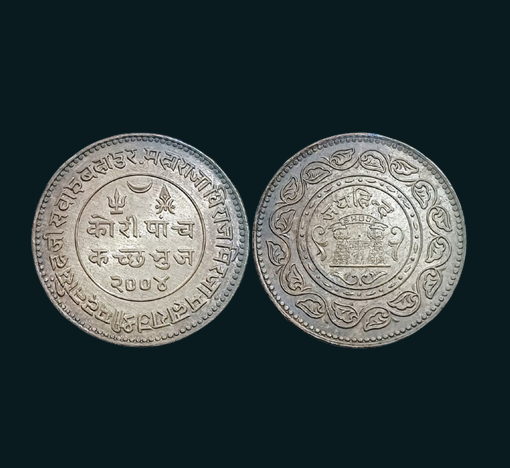
Kutch had a long tradition of independent coinage, primarily based on the kori standard, with smaller denominations including the dokda and dhabu. Coins were principally struck at the Bhuj Mint. During Madansinhji’s reign, silver, gold, and copper coins were issued in his name and dated VS 2004. These represent some of the final coinage issued by the princely state of Kutch. Rather than featuring the name of the British sovereign, the reverse prominently bears the slogan “Jai Hind” (“Victory to India”), reflecting the political transition accompanying India’s independence.
The coin illustrated here is a silver 5 Kori, weighing approximately 13.87 g. The obverse features the Devanagari legend “Maharajadhiraj Mirza Maharao Sri Madansinhaji Sawai Bahadur” within a dotted outer circle. The inner circle bears “Kori 5, Kutch Bhuj, 2004”, surmounted by the traditional Jadeja dynastic emblems of the Trishul (trident), crescent, and Katar (dagger). The reverse depicts the Fortress of Bhuj, the emblem of the state, accompanied by the bold legend “Jai Hind.”
Struck at Bhuj, these coins are scarce to rare in higher grades and are highly prized by collectors. They encapsulate a pivotal moment in Indian history—the transition of a centuries-old Jadeja principality into the newly independent Indian nation. The simple yet powerful words “Jai Hind” give the coins particular historical significance.
As among the final monetary issues of Kutch under its last Maharao, these coins remain enduring symbols of continuity, transition, and national pride.
-
Nawanagar Silver 5 Kori of Jam Shri Vibhaji II
2026-08-18 Tue -
Naga Panchami - Worship of Snake on Coins and Subbaraya Gold Fanam
2026-08-17 Mon -
Tribute on the Eve of India’s 80th Independence Day
2026-08-14 Fri -
Lead Coin with Bow and Arrow of the Rano Vasithiputra Kura
2026-08-13 Thu -
Glimpse into Sri Satkarni’s Reign through his Lead Coin
2026-08-13 Thu