
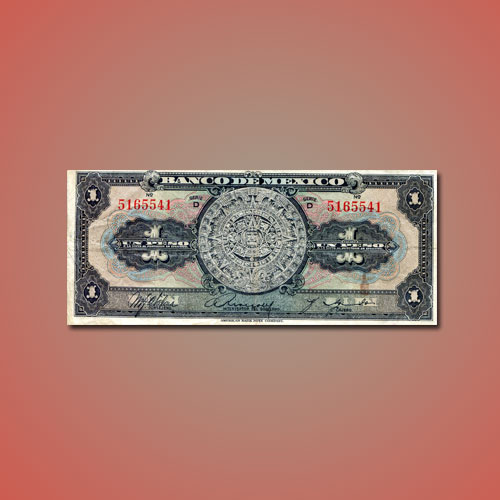
Mexican Archaeological Wonder on a Banknote
2020-06-17 Wed
The first banknotes issued by the Mexican state were produced in 1823 by Emperor Agustin de Iturbide. Several Mexican banknotes bore motifs related to the Aztecs or other pre-Hispanic cultures. The banknote shown above is a 1 Peso banknote issued in the year 1961 which depicts the Mexican Sunstone. The Aztec Calendar Stone, better known in the archaeological literature as the Aztec Sun Stone (Piedra del Sol in Spanish), is an enormous basalt disk covered with hieroglyphic carvings of calendar signs and other images referring to the Aztec creation myth. The so-called Aztec Calendar Stone was not a calendar, but most likely a ceremonial container or altar linked to the Aztec sun god, Tonatiuh, and festivities dedicated to him. The 1 Peso banknote shown above depicts Aztec calendar stone or Mexica Sunstone (Piedra del Sol) excavated in the Zocalo, Mexico City's main square, on the 17th of December 1790, whereas the reverse depicts Independence Monument in Mexico City. Image Courtesy: currencybanknotes.comLatest News
-
Elephant and Lion on a Copper Coin of the Sangam Cholas
2026-09-24 ThuThe elephant and lion were powerful animal symbols in the artistic and political traditions of an...
-
Ganesha and Shiva Together on a Coin of the Shiv Ganga Rajas
2026-09-25 FriOn Anant Chaturdashi, devotees bid farewell to Lord Ganesha with prayers and devotion, celebratin...
-
Elephant on a Punch-Marked Coin of the Vidarbha Janapada
2026-09-23 WedThe history of Indian coinage begins with the remarkable tradition of punch-marked coins, among t...
-
Gandabherunda and Four Elephants on a Gold Half Varaha of Achyutadevaraya
2026-09-23 WedThe Gandabherunda, the mythical two-headed bird of Indian tradition, is one of the most striking ...
-
The Elephant on an Indo-Greek Silver Drachm of Apollodotus I
2026-09-22 TueElephants were not just an important part of Indian heritage and religious traditions; they also ...