
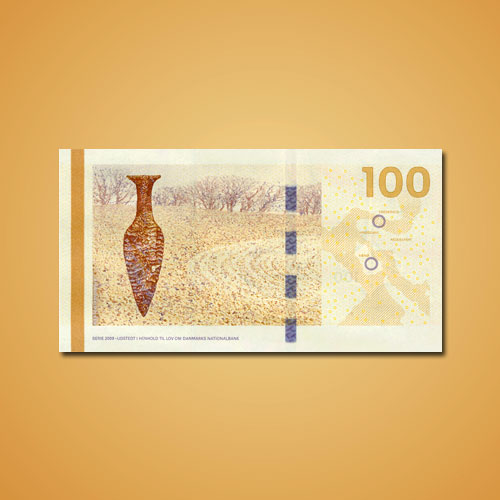
Neolithic Dagger on Danish Banknote
2020-06-16 Tue
Issued in the year 2010, the 100 Kroner Banknote features one of the ancient and most perfect artifacts of the Danish Bygone Era: The Hindsgavl Dagger.In the Neolithic period, the flint workers achieved very high technical standards. The magnificent dagger from Hindsgavl with its blade less than 1 cm thick is the finest example of the flint workers’ outstanding skills at the end of the Stone Age.
It was found around 1876 on the island Fæno in the Little Belt. The dagger type is called a ‘fishtail dagger’ because of the fishtail-formed hilt. Pressure-flaked daggers mark the beginning of the end of the Stone Age and are the reason why the period from 2400-1800 BC is called the Dagger Period.
The archeological masterpiece has been featured on the 100 Kroner banknote of Denmark. The banknote depicts the Little Belt railway bridge on the obverse and the Dagger on the reverse.
Image Courtesy: Wikipedia.
Latest News
-
An Interesting Five-Symbols on Punch-Marked Copper Square Karshapana of Eran
2026-11-18 WedThe ancient region of Eran, situated in present-day Madhya Pradesh, was an important centre of ea...
-
Sacred Symbols and Natural Motifs on Post-Mauryan Coinage of the Eran-Vidisha Region
2026-11-18 WedThe decline of the Mauryan Empire in the second century BCE marked the emergence of several regio...
-
Mithuna (Couple) Type Coin from the Post-Mauryan Ujjaini Region
2026-11-17 TueContinuing our exploration of the distinctive coinage of the Post-Mauryan Ujjaini region, let us ...
-
Lord Shiva Standing Type Copper Coin of the Ujjaini Region from Post-Mauryan Period
2026-11-17 TueThe Post-Mauryan period (200 BCE–300 CE) witnessed the emergence of several regional kingdoms, ...
-
Rare Silver 1½ Shana Punch-Marked Coin of Panchala Janapada
2026-11-16 MonThe Panchala Janapada was one of the sixteen Mahajanapadas of ancient India, flourishing during t...