
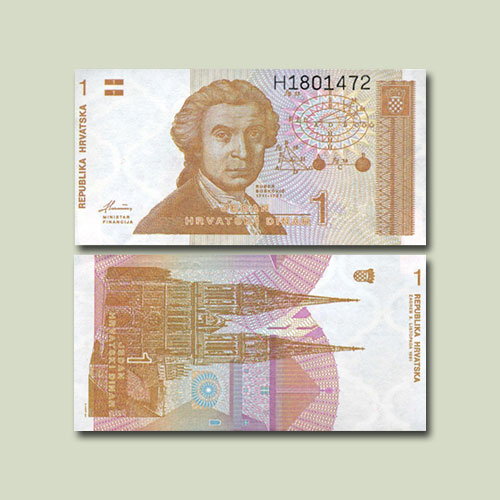
Croatia 1 Dinar banknote of 1991
2019-06-28 Fri
Croatia is an Eastern European country with a long coastline on the Adriatic Sea. Encompassing more than a thousands of islands, it's also crossed by the Dinaric Alps. Its inland capital, Zagreb, is distinguished by its medieval Gornji Grad (Upper Town) and diverse museums. The major coastal city of Dubrovnik has massive 16th-century walls encircling an Old Town with Gothic and Renaissance buildings.The dinar was the currency of Croatia between December 23, 1991, and May 30, 1994. The Croatian dinar replaced the 1990 version of Yugoslav dinar at par. It was a transitional currency introduced following Croatia's declaration of independence from the Socialist Republic of Yugoslavia. The modern and the current currency in use in Croatia, “the kuna”, was introduced on May 30, 1994, starting a transitional period from the Croatian dinar, ending on December 31, 1994.
Today we are discussing Croatia's 1 Dinara banknote of 1991 . The obverse depicts the portrait of Ruder Boshkovich - Croatian mathematician, astronomer and physicist; the reverse features the Zagreb Cathedral.
Image Courtesy: iCollector.com
Latest News
-
Goddess Lakshmi in Padmasana Posture on a Rare Kakatiya Gold Gadyana Coin
2026-11-19 ThuThe Kakatiya dynasty was an important ruling power in the Deccan, with its influence centred arou...
-
Chalukyan-style Temple on Gold Gadyana
2026-11-19 ThuThe Chalukyas of Kalyani, also known as the Western Chalukyas, were an influential ruling dynasty...
-
An Interesting Five-Symbols on Punch-Marked Copper Square Karshapana of Eran
2026-11-18 WedThe ancient region of Eran, situated in present-day Madhya Pradesh, was an important centre of ea...
-
Sacred Symbols and Natural Motifs on Post-Mauryan Coinage of the Eran-Vidisha Region
2026-11-18 WedThe decline of the Mauryan Empire in the second century BCE marked the emergence of several regio...
-
Mithuna (Couple) Type Coin from the Post-Mauryan Ujjaini Region
2026-11-17 TueContinuing our exploration of the distinctive coinage of the Post-Mauryan Ujjaini region, let us ...