
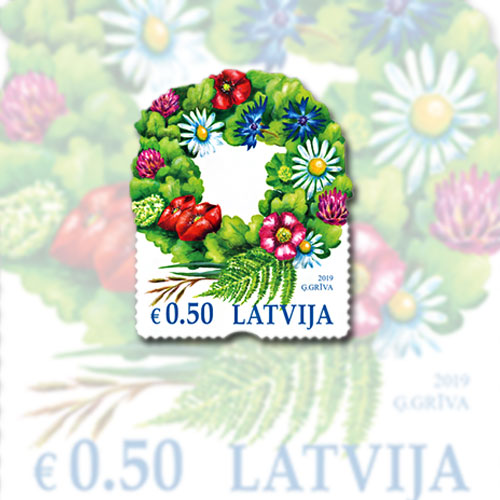
New Latvian Stamp Celebrates the Festival of Summer Solstice
2019-06-21 Fri
Latvia issued a €0.50 self-adhesive stamp on 13th June shaped like a crown of flowers. These crowns are worn during the country’s midsummer festivals, Ligo and Jani. The stamp features a crown made out of different flowers from Latvia and is designed by Girts Griva.Jani is an annual festival which celebrates the summer solstice. The solstice falls on 21st or 22nd June, but Ligo and Jani Days are observed on 23rd and 24th June, respectively. Ligosvetki is the name given to the day before Jani.
People from all over the country gather near the countryside on Jani. They eat, drink, sing and celebrate the solstice by following ancient folk traditions that are associated with prosperity and fertility. Circular wreaths made of flowers, grasses and oak leaves. Wreaths made of twenty-seven flowers and herbs are considered to be auspicious. Wreaths of oak leaves are worn by men denoting the strength of oak trees. Oak wreaths bring in blessings of horses and bees. Jani cheese, fires and wreaths symbolise the sun.
Image Courtesy: Latvian Post
Latest News
-
Goddess Lakshmi in Padmasana Posture on a Rare Kakatiya Gold Gadyana Coin
2026-11-19 ThuThe Kakatiya dynasty was an important ruling power in the Deccan, with its influence centred arou...
-
Chalukyan-style Temple on Gold Gadyana
2026-11-19 ThuThe Chalukyas of Kalyani, also known as the Western Chalukyas, were an influential ruling dynasty...
-
An Interesting Five-Symbols on Punch-Marked Copper Square Karshapana of Eran
2026-11-18 WedThe ancient region of Eran, situated in present-day Madhya Pradesh, was an important centre of ea...
-
Sacred Symbols and Natural Motifs on Post-Mauryan Coinage of the Eran-Vidisha Region
2026-11-18 WedThe decline of the Mauryan Empire in the second century BCE marked the emergence of several regio...
-
Mithuna (Couple) Type Coin from the Post-Mauryan Ujjaini Region
2026-11-17 TueContinuing our exploration of the distinctive coinage of the Post-Mauryan Ujjaini region, let us ...