
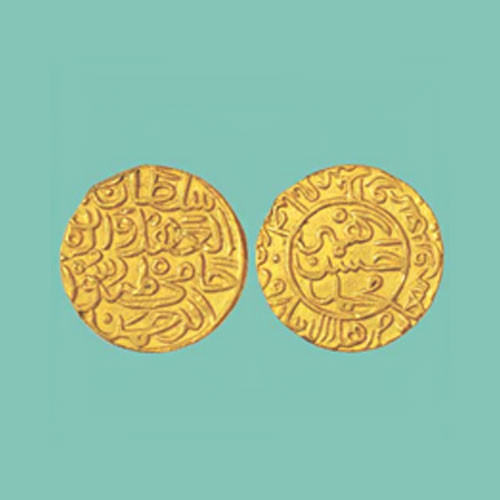
Bahmani Sultanate Coin Collection
2018-12-31 Mon
Rulers of Bahmani Sultanate promoted art, architecture, culture and literature to a great extent. Bahmani Sultanate coins are known for their beautiful calligraphy. They also provide a lot of valuable information like mint name, year of issue, name of the ruler and name of the issuer’s father. This helps us identify the eighteen Bahmani kings easily.Bahmani coins were struck at mints such as Fatahbad (Daulatabad), Ahsanabad (Kalaburagi), Muhamadabad (Bidar) and Goa (Dabul). The first sultan, Alauddin Bahman Shah had named the city of Daulatabad as Fatahbad. The capital was shifted from Fatahbad to Ahsanabad shortly. The latter remained the capital of Bhamani Sultanate during the reign of the first eight rulers. All types of coins were struck here during this time period. When the capital was shifted to Bidar later by Ahmed Shah, the coins were also minted from Muhamadabad and Goa.
History enthusiast Mohammed Ismail has a wonderful collection of almost 1,500 Bahmani coins which comprises 80% of the type of coins that were struck by the Sultanate. He started developing an interest in numismatics from his school days. He started collecting coins from the annual urs fair of the popular Dargah Khawaja Bandanawaz in Kalaburagi. Ismail keeps attending various events and auctions related to numismatics. He is also a part of several related societies and groups.
According to Ismail, Bahmani Sultanate issued gold, silver and copper coin from 1347 to 1538 in varying sizes and weights. Copper coins weighed between 1.8 gram to 16 grams, gold coins weighed between 11 to 20 grams and silver coins weighed one to 11 grams. The denominations were further divided into 1/4, 1/6, 1/16, 1/32 and 1/64 as per Indian traditions. The first sultan Alauddin Bahman Shah issued one gold, four silver and five copper coins in varying sizes. Muhammad Shah released two gold, eight silver and six copper coins. Firuz Shah was the last king to rule from Kalaburagi. He issued two gold, three silver and six copper coins. Ahmed Shah introduced Bidri art and various other types of art and architecture. He released one silver and six copper coins. Alauddin II released two gold, one silver and six copper coins. Humayun Shah released two gold, one silver and four copper coins. Ahmad Shah III released two gold and five copper coins. Muhammad Shah III released one gold, one silver, and six copper coins. The last three rulers minted only copper coins. Most coins were round in shape while some were rectangular. Ismail is now looking to publish a book on Bahmani period coins.
Image Courtesy: Mintage World
Latest News
-
Goddess Lakshmi in Padmasana Posture on a Rare Kakatiya Gold Gadyana Coin
2026-11-19 ThuThe Kakatiya dynasty was an important ruling power in the Deccan, with its influence centred arou...
-
Chalukyan-style Temple on Gold Gadyana
2026-11-19 ThuThe Chalukyas of Kalyani, also known as the Western Chalukyas, were an influential ruling dynasty...
-
An Interesting Five-Symbols on Punch-Marked Copper Square Karshapana of Eran
2026-11-18 WedThe ancient region of Eran, situated in present-day Madhya Pradesh, was an important centre of ea...
-
Sacred Symbols and Natural Motifs on Post-Mauryan Coinage of the Eran-Vidisha Region
2026-11-18 WedThe decline of the Mauryan Empire in the second century BCE marked the emergence of several regio...
-
Mithuna (Couple) Type Coin from the Post-Mauryan Ujjaini Region
2026-11-17 TueContinuing our exploration of the distinctive coinage of the Post-Mauryan Ujjaini region, let us ...