
2026-10-19 Mon
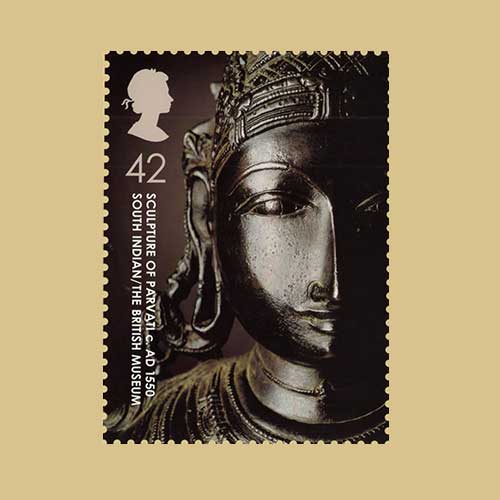
On the auspicious occasion of Navaratri, let us explore a remarkable example of India’s artistic and spiritual heritage being celebrated on an international postage stamp. In 2003, the Royal Mail of the United Kingdom issued a commemorative set featuring six extraordinary artefacts from the collections of the British Museum. Among them was a 42-pence stamp depicting a South Indian sculpture of Goddess Parvati, dating to approximately AD 1550. This beautiful representation of the Hindu goddess brought India’s rich sculptural tradition to a wider international audience.
The story behind this stamp issue is connected to Sir Hans Sloane, an eminent physician, naturalist, and collector whose extensive collection of books, manuscripts, natural history specimens, and antiquities laid the foundation for the British Museum. Following his death in 1753, his collection was bequeathed to the nation, leading to the establishment of the museum in 1753. The 2003 stamp issue commemorated the 250th anniversary of his death and celebrated the extraordinary diversity of the museum’s collections.
The six stamps showcased objects representing different civilisations and periods in world history. These included the Coffin of Denytenamun from ancient Egypt, dating to around 900 BC; a representation of Alexander the Great from the Hellenistic world, dating to around 200 BC; the Sutton Hoo helmet from Anglo-Saxon England, dating to approximately AD 600; the Mask of Xiuhtecuhtli from the Mixtec-Aztec cultural tradition, dating to around AD 1500; and the sculpture known as Hakananai'a from Easter Island, dating to approximately AD 1000. Completing this distinguished selection was the sculpture of Goddess Parvati from South India.
Goddess Parvati is revered in Hinduism as the consort of Lord Shiva and the mother of Lord Ganesha and Lord Kartikeya. She embodies love, devotion, fertility, strength, and the nurturing power of the Divine Mother. Her many forms reflect the diverse ways in which Shakti is worshipped throughout India.
The sculpture featured on the British stamp represents the excellence of South Indian religious art around the 16th century. Its inclusion in the British Museum anniversary issue highlights the significance of Indian sculpture within the broader history of world art.
As we celebrate Navaratri, the stamp serves as a reminder of the enduring influence of the Divine Feminine and the remarkable ability of art and philately to connect cultures. Through this small yet meaningful tribute, the Royal Mail brought a representation of India’s sacred artistic heritage to collectors and admirers around the world.
The 42-pence Parvati stamp remains an interesting piece for philatelists, art historians, and devotees alike—a meeting point of faith, craftsmanship, and international cultural heritage.
-
Celebrate the Spirit of Dussehra through Philately
2026-10-20 TueAs we celebrate the joyous festival of Dussehra, let us explore a special postage stamp that capt...
-
Goddess Durga on an East German Postage Stamp
2026-10-17 SatThe artistic and spiritual heritage of India has travelled far beyond its geographical boundaries...
-
Goddess Durga form – Palanchowk Bhagwati on a Nepalese Postage Stamp
2026-10-17 SatToday, we celebrate the seventh day of Navratri, dedicated to Goddess Kalaratri, one of the power...
-
Celebrating the Spirit of Durga Puja through a Child’s Art Stamp
2026-10-16 FriWith Navratri celebrations in full swing, it is the perfect time to look back at a wonderfully vi...
-
Goddess Durga on a Gupta-Period Terracotta Plaque on India’s 1989 Stamp
2026-10-16 FriAs today marks the sixth day of Navratri, we pay tribute to Goddess Durga, the embodiment of divi...