
2026-09-30 Wed
The Sangam Chola or Early Cholas were a Tamil kingdom of the Chola dynasty - pre and post Sangam period (600 BCE–300 CE). It was one of the three main kingdoms of Tamilakam. Their early capitals were Urayur or Tiruchirapalli and Kaveripattinam. Along with the Pandyas and the Cheras, the Chola history goes back to the period when written records were scarce. Their early heartland lay in the fertile Kaveri basin, with Uraiyur serving as an important political centre and Kaveripattinam (Puhar) developing as a major port.
Sangam literature provides valuable information about their rulers, warfare, administration, trade and society. Among the best-known early Chola rulers was Karikala Chola, whose reign is traditionally associated with major military victories, the strengthening of Chola power, agricultural development and improvements to the Kaveri region.
Karikala is also traditionally credited with the construction of the Kallanai (Grand Anicut), one of the most celebrated ancient irrigation works of Tamil Nadu. Puhar became an important centre of maritime and commercial activity, linking the Chola realm with wider Indian Ocean trade networks. The period also witnessed a flourishing of Tamil literature and a distinctive artistic and numismatic tradition. Chola coinage of the Sangam age frequently employed powerful animal motifs, particularly the tiger, the dynasty's established emblem, while elephants and other symbols also occur on early issues.
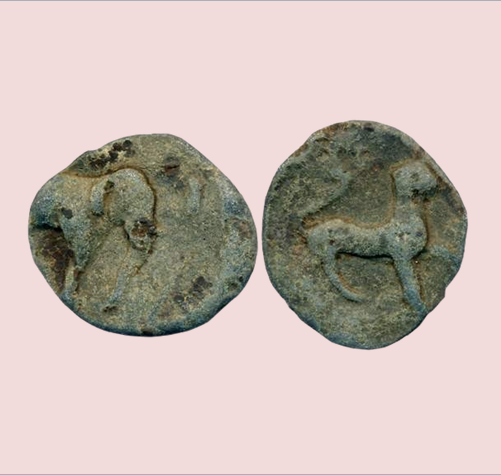
This 4.46 g lead coin, attributed to the Sangam Cholas, is a particularly unusual example of early Chola coinage. The obverse depicts an elephant standing and facing right, while the reverse features a tiger/lion facing right, creating a striking pairing of two powerful animals associated with strength, authority and royal imagery.
Early Chola coins are known for communicating through symbolic designs rather than lengthy legends, and animal motifs form an important part of this visual language. While the tiger is the most securely established Chola dynastic emblem, elephants, lions and other animals also appear on coins attributed to the Sangam Cholas, demonstrating the diversity of their numismatic imagery.
What makes this specimen especially noteworthy is its lead fabric: lead Chola coins are considerably rarer than the more commonly encountered copper issues, making this example an important piece for the study and collection of early Chola coinage. The coin offers a fascinating glimpse into the symbolic vocabulary and metallurgical variety of Sangam-period Chola numismatics.
-
The Horse and a River-Map on a Coin of the Malayaman Chiefs of Sangam Age
2026-09-30 WedThe Malayaman chiefs were among the regional chieftains who ruled parts of northern Tamilakam dur...
-
Vikrama Pandya and the “Konerinmai-kondan” Copper Half Cash
2026-09-29 TueFor centuries, the Pandyas played a significant role in the history of southern India, forming on...
-
Narasimha on a Copper Kasu of the Kongu Cheras
2026-09-29 TueThe Chera dynasty was one of the three great ruling houses of ancient Tamilakam, alongside the Ch...
-
Twin Fishes and Bull on a Pandya Copper Coin
2026-09-28 MonThe Pandyas were one of the three great Tamil dynasties of the Sangam age, alongside the Cheras a...
-
Sangam-Age Chola Copper Coin with Lion/Tiger, Elephant and Auspicious Symbols
2026-09-28 MonThe Cholas were one of the three major Tamil dynasties of the Sangam age, alongside the Cheras an...