
2026-09-29 Tue
For centuries, the Pandyas played a significant role in the history of southern India, forming one of the three great Tamil dynasties of ancient South India alongside the Cheras and Cholas. Madurai served as their principal centre, while Korkai was associated with maritime trade and pearl fisheries. Their distinctive fish emblem became a lasting symbol of Pandya authority and an important feature of their coinage.
Early Pandya coinage included punch-marked silver and copper issues, while later rulers introduced die-struck coins featuring royal names, symbols and religious imagery.
The history of the Pandyas, however, continued beyond their 13th-century imperial zenith. During the 14th and early 15th centuries, the political authority of the dynasty became increasingly fragmented, and different members or branches of the Pandya line continued to exercise power in parts of Tamil Nadu. One of these later rulers was Vikrama Pandya, who is associated with the early 15th century and is generally dated to around 1410–1420 CE.
Vikrama Pandya's historical importance therefore lies not only in his position within the later Pandya tradition but also in the evidence for his continuing authority in the Tamil country during a period when regional political relationships were changing. His inscriptions show that he continued to use the grand royal title Konerinmai-kondan, while the survival of his coinage provides additional evidence for the exercise of political authority.
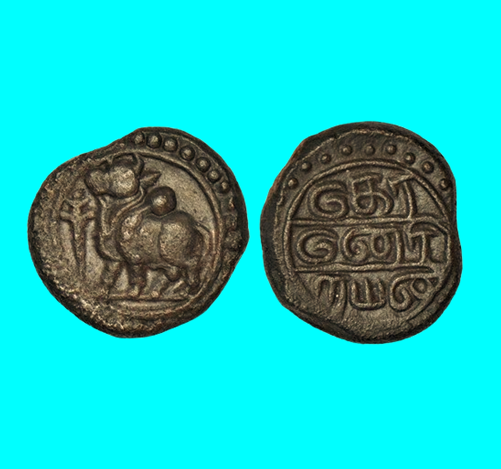
The displayed copper ½ Cash, of Vikrama Pandya and weighs 3.70 g. It is described as a coin of the Hindu kingdoms of Tamil Nadu and is associated with Vikrama Pandya under the title “Konerinmai-kondan”. On the obverse, a bull walks towards the left, with a downward-pointing sword to its left. The reverse carries a Tamil legend arranged in three lines: Ko / neri / rayan.
The title Konerinmai-kondan itself has a history extending beyond Vikrama Pandya. Epigraphic evidence shows its use by earlier South Indian rulers, including Kulottunga Chola III and a later Sundara Pandya, before its appearance in an inscription of Vikrama Pandya in 1418. This continuity illustrates how royal titles could be adopted and reused across dynasties, carrying associations of sovereignty and conquest even when political circumstances had changed.
-
Narasimha on a Copper Kasu of the Kongu Cheras
2026-09-29 TueThe Chera dynasty was one of the three great ruling houses of ancient Tamilakam, alongside the Ch...
-
Twin Fishes and Bull on a Pandya Copper Coin
2026-09-28 MonThe Pandyas were one of the three great Tamil dynasties of the Sangam age, alongside the Cheras a...
-
Sangam-Age Chola Copper Coin with Lion/Tiger, Elephant and Auspicious Symbols
2026-09-28 MonThe Cholas were one of the three major Tamil dynasties of the Sangam age, alongside the Cheras an...
-
Elephant and Lion on a Copper Coin of the Sangam Cholas
2026-09-24 ThuThe elephant and lion were powerful animal symbols in the artistic and political traditions of an...
-
Ganesha and Shiva Together on a Coin of the Shiv Ganga Rajas
2026-09-25 FriOn Anant Chaturdashi, devotees bid farewell to Lord Ganesha with prayers and devotion, celebratin...