
2026-09-29 Tue
The Chera dynasty was one of the three great ruling houses of ancient Tamilakam, alongside the Cholas and Pandyas. Known in early sources as the Ceras or Keralaputras, the Cheras controlled territories corresponding broadly to parts of present-day Kerala and western Tamil Nadu. They are documented from at least the 3rd century BCE, and their power was closely connected with the commercial networks of the western coast and the Indian Ocean. The Cheras are prominent in Sangam literature, which preserves accounts of their rulers, warfare, trade and patronage.
During early medieval period, a branch of the Chera family became associated with the Kongu region, centred on Karur in present-day Tamil Nadu. These rulers are generally known as the Kongu Cheras or Cheras of Karur. The dynasty claimed descent from the earlier Cheras, although the precise relationship between the different Chera branches is not completely understood. Karur acquired renewed importance between approximately the 8th and 9th centuries CE, and the Kongu Cheras exercised authority in parts of western Tamil Nadu, with connections extending towards the older Chera territories in Kerala.
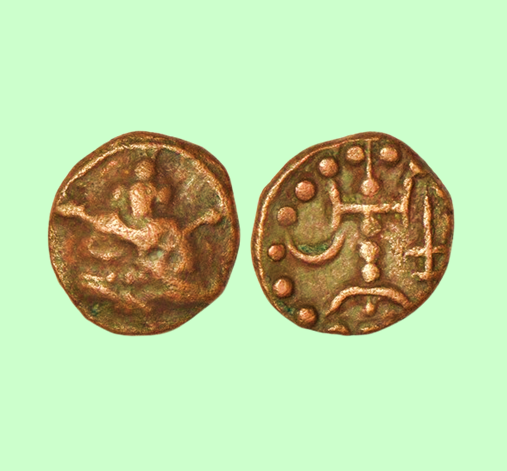
Here, the shown copper kasu of the Kongu Cheras, dated approximately to the 13th century CE. The coin weighs 1.16 g. On the obverse is a stylized representation of Narasimha seated facing, while the reverse displays a trisula-like lamp on a pedestal at the centre, accompanied by a sword on the right and a crescent on the left.
Narasimha, meaning “Man-Lion”, is one of the most distinctive incarnations of Vishnu in Hindu tradition. He combines the human and leonine forms and is traditionally counted as the fourth avatar of Vishnu in the widely known Dashavatara sequence.
The appearance of Narasimha on the Kongu Chera copper kasu therefore carries considerable cultural significance. The coin places a major Vaishnava deity within the monetary landscape of medieval Kongu, while its stylized seated figure demonstrates how religious imagery could serve as a powerful visual element even on small copper denominations. Although the absence of a legend prevents the coin from being linked securely to a named ruler, its imagery connects the numismatic traditions of the Kongu region with the long and evolving history of Narasimha worship in South India.
-
Vikrama Pandya and the “Konerinmai-kondan” Copper Half Cash
2026-09-29 TueFor centuries, the Pandyas played a significant role in the history of southern India, forming on...
-
Twin Fishes and Bull on a Pandya Copper Coin
2026-09-28 MonThe Pandyas were one of the three great Tamil dynasties of the Sangam age, alongside the Cheras a...
-
Sangam-Age Chola Copper Coin with Lion/Tiger, Elephant and Auspicious Symbols
2026-09-28 MonThe Cholas were one of the three major Tamil dynasties of the Sangam age, alongside the Cheras an...
-
Elephant and Lion on a Copper Coin of the Sangam Cholas
2026-09-24 ThuThe elephant and lion were powerful animal symbols in the artistic and political traditions of an...
-
Ganesha and Shiva Together on a Coin of the Shiv Ganga Rajas
2026-09-25 FriOn Anant Chaturdashi, devotees bid farewell to Lord Ganesha with prayers and devotion, celebratin...