
2026-09-28 Mon
The Pandyas were one of the three great Tamil dynasties of the Sangam age, alongside the Cheras and Cholas. Their early kingdom was centred on Madurai, while the ancient port of Korkai was an important centre associated with the Pandya realm. The dynasty's distinctive emblem was the fish, and fish motifs became one of the most enduring identifiers of Pandya coinage.
The importance of Pandya coinage extends beyond the Tamil mainland. A considerable number of early South Indian coins have been discovered in Sri Lanka (Ceylon), reflecting the close commercial and cultural connections between the two regions. The Colombo National Museum, for example, holds a substantial collection of South Indian coins found in Sri Lanka.
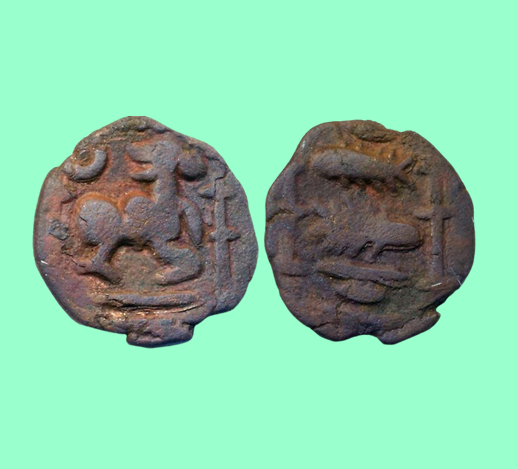
Here, the intriguing copper coin weighs 4.38 g, attributed to the Sangam-age Pandyas of Ceylon, with a bull seated facing right on the obverse and two fishes on the reverse.
Bull imagery had a broad religious and cultural significance in ancient India. It could evoke strength, fertility and royal power, while in the Tamil region the bull was also deeply embedded in the cultural landscape.
Comparable Sri Lankan finds have produced coins featuring a couching or seated bull on one side and two fishes on the other. One documented series is specifically described as a "Bull and Fish Type," consisting of an irregular copper coin with a seated bull on the obverse and two or three fishes on the reverse.
The reverse presents the “two fishes”. The fish was the principal dynastic emblem of the Pandyas and remained an important feature of their coinage across different periods. Early Pandya coins can show a single stylised fish, while later and regional varieties frequently display two fishes, sometimes arranged vertically and sometimes horizontally.
The appearance of the twin fishes on this coin is therefore particularly significant. In a coin without a written legend, the emblem provides an important visual clue to its Pandya association.
This 4.38 g copper coin attributed to the Sangam-age Pandyas in Ceylon, with its seated bull and twin fishes, is a fascinating example of the close numismatic relationship between the Tamil country and ancient Sri Lanka.
Its significance lies not merely in the simplicity of its design, but in the historical information encoded in those two motifs. The bull connects the coin with a distinctive group of early copper issues, while the two fishes immediately evoke the Pandya dynastic identity. Coins of related types discovered in Sri Lanka demonstrate the importance of this imagery in the island's early numismatic record.
-
Sangam-Age Chola Copper Coin with Lion/Tiger, Elephant and Auspicious Symbols
2026-09-28 MonThe Cholas were one of the three major Tamil dynasties of the Sangam age, alongside the Cheras an...
-
Elephant and Lion on a Copper Coin of the Sangam Cholas
2026-09-24 ThuThe elephant and lion were powerful animal symbols in the artistic and political traditions of an...
-
Ganesha and Shiva Together on a Coin of the Shiv Ganga Rajas
2026-09-25 FriOn Anant Chaturdashi, devotees bid farewell to Lord Ganesha with prayers and devotion, celebratin...
-
Elephant on a Punch-Marked Coin of the Vidarbha Janapada
2026-09-23 WedThe history of Indian coinage begins with the remarkable tradition of punch-marked coins, among t...
-
Gandabherunda and Four Elephants on a Gold Half Varaha of Achyutadevaraya
2026-09-23 WedThe Gandabherunda, the mythical two-headed bird of Indian tradition, is one of the most striking ...