
2026-09-23 Wed
The history of Indian coinage begins with the remarkable tradition of punch-marked coins, among the earliest forms of coinage produced in the Indian subcontinent. Emerging during the early historic period, around the 6th century BCE or slightly earlier according to different scholarly chronologies, these coins were generally made by punching individual symbols onto small pieces of metal rather than striking them between engraved dies. Silver karshapanas became an important monetary form, and the tradition was adopted by various Janapadas and Mahajanapadas.
Unlike later coins that commonly carried portraits, inscriptions or a single centrally designed type, punch-marked coins are characterised by groups of symbols impressed separately on the metal. The number, arrangement and sequence of these punches provide important clues for classifying different series and regional traditions. The karshapana and its fractional denominations circulated widely, reflecting the growing importance of monetary exchange and long-distance trade in early historic India.
Among the regional traditions of punch-marked coinage are the issues attributed to the Vidarbha Janapada. The Vidarbha region, corresponding broadly to parts of present-day eastern Maharashtra, produced distinctive archaic punch-marked coins whose attribution is based on their characteristics, find-spots and regional associations. Coins attributed to Vidarbha are known from different areas, including the Melghat region and the Godavari Valley, and occur in a variety of fractional karshapana types.
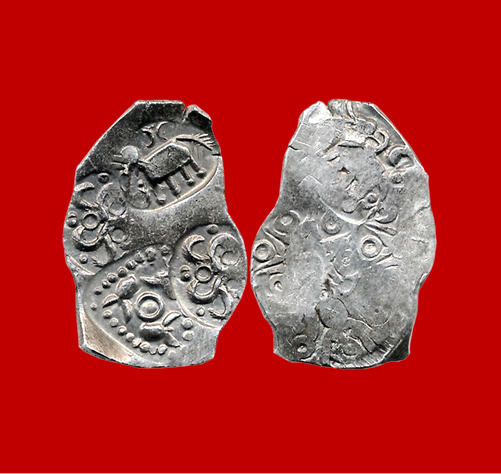
Here, the coin is a Silver ½ Karshapana weighing 1.67 g, attributed to the Vidarbha Janapada of the Melghat region. It belongs to Series II and is described as a uniface issue with a four-symbol ABCB configuration. A comparable example with precisely this weight and combination is catalogued as P. Kulkarni M171R. The four-symbol arrangement is conventionally described as:
• A: Elephant walking to the left × 1
• B: Six-pointed star × 2
• C: Unidentified symbol × 1
• B: Six-pointed star, producing the ABCB configuration
The elephant is especially significant within the visual vocabulary of ancient Indian coinage. It was closely associated with royal power, warfare, prestige and ceremonial life. Its appearance on early regional coinage therefore provides an intriguing glimpse into the symbolic world of the communities that produced and used these coins. Another characteristic feature of this specimen is its uniface nature. The principal punches are concentrated on one side of the coin, while the reverse is blank. This is consistent with the manufacture of many early punch-marked issues, where individual symbols were impressed independently onto the metal rather than being produced by a conventional obverse and reverse die.
-
Gandabherunda and Four Elephants on a Gold Half Varaha of Achyutadevaraya
2026-09-23 WedThe Gandabherunda, the mythical two-headed bird of Indian tradition, is one of the most striking ...
-
The Elephant on an Indo-Greek Silver Drachm of Apollodotus I
2026-09-22 TueElephants were not just an important part of Indian heritage and religious traditions; they also ...
-
Gajalakshmi Flanked by Elephants on a Post-Mauryan Ujjaini Copper Coin
2026-09-22 TueThe association between Gajalakshmi and elephants is one of the most enduring motifs in Indian re...
-
Elephant Head on a Bronze Coin of Indo-Scythian King Maues
2026-09-21 MonAs the eighth day of Ganesh Utsav is celebrated, the elephant once again provides a fascinating l...
-
A Remarkable Elephant-and-Lion Standard on Vrishni Coinage
2026-09-21 MonAs Ganesh Utsav continues, the elephant once again offers a fascinating doorway into India’s an...