
2026-09-23 Wed
The Gandabherunda, the mythical two-headed bird of Indian tradition, is one of the most striking motifs found on the coinage of the Vijayanagara Empire. Its formidable appearance—two heads, outstretched wings and extraordinary strength—made it an especially powerful emblem in South Indian artistic traditions. On the gold coinage of Achyutadevaraya, the Gandabherunda is depicted in an extraordinary form, holding four elephants, creating one of the most distinctive animal compositions in Vijayanagara numismatics.
The Vijayanagara Empire, founded in the 14th century, became one of the major political and cultural powers of South India. Its rulers patronised temples, literature, architecture and the arts, while their coinage developed a rich repertoire of religious, mythological and royal imagery. The Tuluva dynasty produced some of the most recognisable Vijayanagara coins, including those of Krishnadevaraya and his successor, Achyutadevaraya.
Achyutadevaraya ruled from 1529 to 1542 CE, succeeding his illustrious elder brother Krishnadevaraya. His reign continued the Vijayanagara monetary tradition, with gold varaha and fractional denominations forming an important part of the coinage.
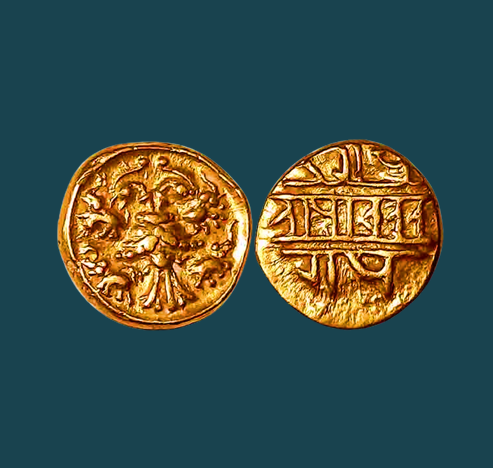
The coin illustrated here is a Gold ½ Varaha, weighing approximately 1.68 g, belonging to the celebrated Gandabherunda type.
The obverse presents the remarkable figure of the Gandabherunda, a two-headed mythical bird. In this type, the bird is shown with an elephant held in each of its two beaks and another elephant grasped by each of its two feet or claws—four elephants in all.
The combination of the double-headed bird and four elephants produces an image of immense visual force. The elephant itself was deeply associated with kingship, warfare, ceremony and royal power in South Asian traditions. The Gandabherunda, meanwhile, was an exceptional mythological creature whose representation appears in the artistic traditions of South India. Its appearance on Vijayanagara coinage demonstrates how a relatively small gold flan could carry an elaborate and highly symbolic royal image.
The reverse carries a three-line Devanagari/Nagari legend, generally read as, “Sri Pratapachutaraya”.
The legend is understood as referring to Pratapa Achyutaraya, the royal name of Achyutadevaraya. Comparable specimens record the legend in three lines as Sri Pra / tapa Chyuta / raya, with variations in the exact lettering and arrangement.
This remarkable gold half Varaha thus brings together mythology, elephants, royal symbolism and Vijayanagara craftsmanship in a single miniature object, making it an especially fascinating piece of medieval Indian numismatic heritage.
-
Elephant on a Punch-Marked Coin of the Vidarbha Janapada
2026-09-23 WedThe history of Indian coinage begins with the remarkable tradition of punch-marked coins, among t...
-
The Elephant on an Indo-Greek Silver Drachm of Apollodotus I
2026-09-22 TueElephants were not just an important part of Indian heritage and religious traditions; they also ...
-
Gajalakshmi Flanked by Elephants on a Post-Mauryan Ujjaini Copper Coin
2026-09-22 TueThe association between Gajalakshmi and elephants is one of the most enduring motifs in Indian re...
-
Elephant Head on a Bronze Coin of Indo-Scythian King Maues
2026-09-21 MonAs the eighth day of Ganesh Utsav is celebrated, the elephant once again provides a fascinating l...
-
A Remarkable Elephant-and-Lion Standard on Vrishni Coinage
2026-09-21 MonAs Ganesh Utsav continues, the elephant once again offers a fascinating doorway into India’s an...