
2026-09-18 Fri
The elephant holds a revered place in India’s religious and cultural traditions. In Maharashtra, Karnataka and Tamil Nadu, the elephant-headed Lord Ganesha is worshipped as the remover of obstacles and a deity associated with wisdom and prosperity. In Kerala, temple elephants form an important part of ceremonial traditions and major temple festivals. In several other parts of India, elephants are also associated with royal processions, temples, mythology and sacred art, reflecting their enduring symbolic importance.
This cultural significance of the elephant finds a fascinating expression in the coinage of the Rashtrakutas, one of the major imperial powers of early medieval India. Their dominion, centred in the Deccan, expanded considerably under powerful rulers, and their coinage employed a variety of distinctive symbols and legends.
Among the notable Rashtrakuta rulers was Amoghavarsha I (c. 814–878 CE), who succeeded his father Govinda III. He ruled for several decades and is remembered as an important patron of literature, religion and the arts. His reign saw the consolidation of Rashtrakuta power in the Deccan. Amoghavarsha was associated with Jainism while also showing devotion to Hindu traditions, including the worship of Mahalakshmi of Kolhapur.
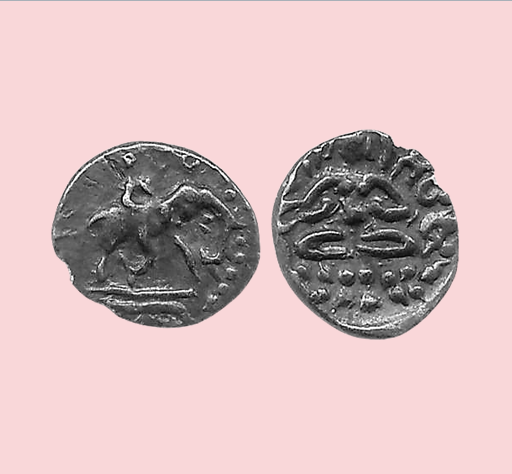
This silver dramma weighs 0.50 g of Amoghavarsha I presents an elephant and rider as its principal motif. On the obverse, an elephant carrying a rider marches towards the right, with the sun and crescent moon depicted above.
The imagery of the elephant and rider conveys a strong association with royal authority and martial power, while the celestial symbols may represent auspiciousness and sovereignty. Comparable silver drammas of Amoghavarsha with an elephant and rider, sun and moon above are documented in numismatic auction records.
The reverse features a Garuda/ Laxmi seated facing forward on a lotus, accompanied by a Brahmi legend.
Garuda was an important emblem in Rashtrakuta symbolism, and the seated Laxmi/ Gajalakshmi type is also found on other Rashtrakuta issues and associated with the prosperity, royalty, fertility, and divine power.
-
Mithuna (Couple) Type Coin from the Post-Mauryan Ujjaini Region
2026-11-17 TueContinuing our exploration of the distinctive coinage of the Post-Mauryan Ujjaini region, let us ...
-
Lord Shiva Standing Type Copper Coin of the Ujjaini Region from Post-Mauryan Period
2026-11-17 TueThe Post-Mauryan period (200 BCE–300 CE) witnessed the emergence of several regional kingdoms, ...
-
Rare Silver 1½ Shana Punch-Marked Coin of Panchala Janapada
2026-11-16 MonThe Panchala Janapada was one of the sixteen Mahajanapadas of ancient India, flourishing during t...
-
Earth God on Panchala Copper Coin of King Bhumimitra
2026-11-16 MonThe ancient kingdom of Panchala was one of the prominent Mahajanapadas of northern India. Located...
-
Silver Punch-Marked Coin of Vidarbha Janapada – Melghat Region
2026-11-13 FriThe emergence of Janapadas during the ancient period marked an important phase in India's politic...