
2026-09-07 Mon
The Licchhavis ruled the Kathmandu Valley during Nepal’s classical period, broadly from the 5th to the 8th century CE. Their coinage represents one of the earliest substantial traditions of locally issued currency in the Kathmandu Valley and reflects the religious, cultural and artistic influences of the wider Indian subcontinent.
This dynasty is traditionally associated with the establishment of an important early kingdom in the Kathmandu Valley. Its rulers maintained political and cultural connections with the great powers of northern India while developing their own distinctive traditions. Inscriptions provide much of our historical knowledge of the period, while the surviving coins offer valuable evidence of political authority, religious beliefs and artistic expression. Licchhavi copper coins are particularly notable for their religious symbols and legends written in forms of the Gupta/Brahmi script.
In the later Licchhavi period Jishnu Gupta was a member of the Abhira-Gupta family who exercised considerable political authority in Nepal during the 7th century. He emerged as the effective power behind the government.
His coinage is particularly important because it places his name directly on a distinctive copper currency. The series belongs to the religiously inspired tradition of early Nepalese coinage, in which legends and sacred symbols often occupied the principal fields rather than conventional royal portraits. The coins of the period demonstrate the close relationship between political authority and religious symbolism in the Kathmandu Valley.
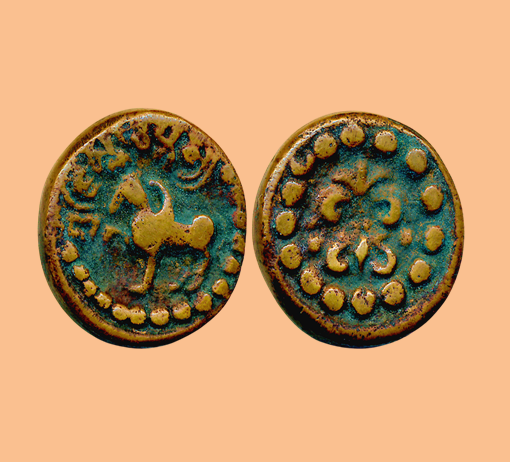
One of the most striking features of the Jishnu Gupta type is the winged animal on the obverse. The concept of a winged bull is one of the most famous examples is the Assyrian lamassu, a monumental protective creature with a human head, bull's body and wings. Such figures were placed at the entrances of Assyrian palaces and served as powerful guardians.
However, the Jishnu Gupta coin therefore belongs to a cultural environment in which the bull already carried strong religious and symbolic associations. The addition of wings makes the creature unusual and gives the design an elevated, possibly divine character.
Here, the copper coin weighs 10.88 grams. The obverse depicts a winged bull facing left appears within a dotted circle; above the animal is the Brahmi legegends. The reverse has an ornate Shrivatsa symbol occupies the centre, enclosed within a dotted circle. The Shrivatsa is an ancient auspicious symbol associated particularly with Lakshmi, prosperity and good fortune, and it became an important religious motif in Indian art and coinage. Its presence reinforces the strongly symbolic character of Licchhavi currency.
-
Bronze Coin of Zeionises, Kshatrapa of Chuksa
2026-10-22 ThuThe Indo-Scythians, also known as the Sakas, were Central Asian peoples who migrated into the nor...
-
Silver Drachma of the Western Kshatrapas Ruler Viradaman
2026-10-22 ThuThe Western Kshatrapas were an important dynasty that ruled parts of western and central India, p...
-
Silver Tetradrachm of the Northern Kshatrapas
2026-10-21 WedThe Kshatrapas of Kashmir form part of the fascinating history of the northwestern Indian subcont...
-
Numismatics Masterpiece - Gold Dodda Honnu of Krishnadevaraya, Vijayanagara Empire
2026-10-21 WedThe Vijayanagara Empire, founded in 1336, was one of the most influential powers in medieval Sout...
-
Celebrate the Spirit of Dussehra through Philately
2026-10-20 TueAs we celebrate the joyous festival of Dussehra, let us explore a special postage stamp that capt...