
2026-09-05 Sat
The Cooch Behar State, situated in the northern part of West Bengal, emerged as an important kingdom of the Koch dynasty. Its history can be traced to the early sixteenth century, when Viswa Singha established the Koch kingdom. His successor, Nara Narayan, transformed it into a powerful regional state, while his brother and military commander Chilarai played a major role in expanding its influence. Over time, the kingdom came to be known as Cooch Behar and maintained its distinctive political and cultural identity in northeastern India.
Cooch Behar developed a particularly interesting tradition of coinage. Its rulers issued coins bearing Bengali inscriptions and the distinctive title and regnal dating system known as Koch Rajsaka. Even after the state entered into a subsidiary alliance with the British in the late eighteenth century, the ruling house retained the right to issue its own ceremonial coinage. The traditional Narayani rupee, associated with the state's earlier monetary tradition, became an important symbol of the dynasty's sovereignty and continued to influence later ceremonial issues.
Maharaja Jagaddipendra Narayan succeeded to the throne of Cooch Behar in 1922, following the death of his father, Maharaja Jitendra Narayan. His reign belonged to a period when Cooch Behar was increasingly exposed to modern administrative, educational and social institutions. The Maharaja received a modern education and later became closely associated with public life beyond the confines of the princely state. His reign continued the process of modernization undertaken by his predecessors, particularly in the fields of education, administration and public institutions. He was a keen sportsman and played cricket at a high level.
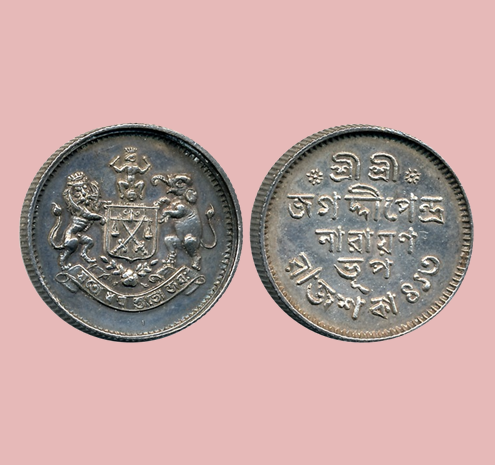
Among the rarest issues of this period is the Silver Ceremonial Nazarana ½ Rupee, issued during the early reign of Jagaddipendra Narayan and dated Koch Rajsaka 413, corresponding to AD 1923. This remarkable specimen weighs 5.66 g. Its obverse departs from the more traditional portrait-based approach and prominently displays the coat of arms of Cooch Behar, supported by a lion and an elephant, with “Grish” appearing below. The heraldic composition conveys the authority and identity of the princely state in a particularly striking manner. The reverse carries the Bengali legend. “Sri Sri / Jagaddipendra / Narayana / Bhup / Raja Saka 413”
The present coin is described as toned, about uncirculated and extremely rare. Its relatively high degree of preservation allows the principal design elements to remain clearly visible, while the natural toning adds character to the silver surface.
-
Bronze Coin of Zeionises, Kshatrapa of Chuksa
2026-10-22 ThuThe Indo-Scythians, also known as the Sakas, were Central Asian peoples who migrated into the nor...
-
Silver Drachma of the Western Kshatrapas Ruler Viradaman
2026-10-22 ThuThe Western Kshatrapas were an important dynasty that ruled parts of western and central India, p...
-
Silver Tetradrachm of the Northern Kshatrapas
2026-10-21 WedThe Kshatrapas of Kashmir form part of the fascinating history of the northwestern Indian subcont...
-
Numismatics Masterpiece - Gold Dodda Honnu of Krishnadevaraya, Vijayanagara Empire
2026-10-21 WedThe Vijayanagara Empire, founded in 1336, was one of the most influential powers in medieval Sout...
-
Celebrate the Spirit of Dussehra through Philately
2026-10-20 TueAs we celebrate the joyous festival of Dussehra, let us explore a special postage stamp that capt...