
2026-09-05 Sat
The coinage of the Cooch Behar State occupies a distinctive place in the history of Indian princely-state coinage. Among its later issues are the ceremonial Nazarana pieces struck during the reign of Maharaja Nripendra Narayan.
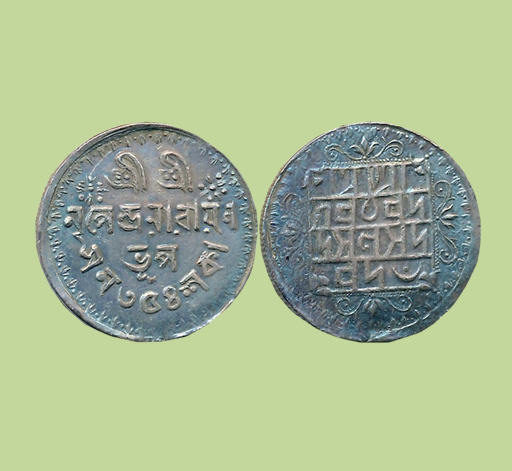
This remarkable coin weighs 4.40 g and belongs to the early part of Nripendra Narayan's reign. Its obverse bears the Bengali legend, “Shri Shri / Nripendra Narayana / Bhup Sana 354 Saka” while the reverse carries, “Shri Shri / Siva Charana / Kamala Madhu / Karasya.” The reverse inscription is enclosed within a square, with decorative scrollwork filling the surrounding quadrants.
Nripendra Narayan was born into the Koch Behar royal family and succeeded to the throne after the death of his father, Maharaja Narendra Narayan, in 1863. He was only about ten months old at the time and was proclaimed Maharaja in the same year. Because of his infancy, the affairs of the state were initially conducted under regency.
As he matured, Nripendra Narayan developed into a progressive and reform-minded ruler. His reign witnessed important developments in education and social administration. In 1884, palace slavery was abolished, reflecting his efforts to modernise the institutions of the princely state. He also supported and endowed educational institutions, helping expand opportunities for his subjects.
The history of this coin is closely connected with the changing monetary system of Cooch Behar. Nripendra Narayan's ceremonial issues are particularly significant because they represent an important technological transition. They were the first Cooch Behar ceremonial coins to be struck using imported minting machinery, rather than being produced entirely by traditional methods.
The present 1864 silver ½ Rupee Nazarana, however, is an outstanding exception. Its well-defined legends and design details demonstrate the quality that could be achieved when the machinery was successfully operated. Combined with its extremely fine condition and attractive patination, the coin stands apart from many of the surviving examples of this type.
-
Bronze Coin of Zeionises, Kshatrapa of Chuksa
2026-10-22 ThuThe Indo-Scythians, also known as the Sakas, were Central Asian peoples who migrated into the nor...
-
Silver Drachma of the Western Kshatrapas Ruler Viradaman
2026-10-22 ThuThe Western Kshatrapas were an important dynasty that ruled parts of western and central India, p...
-
Silver Tetradrachm of the Northern Kshatrapas
2026-10-21 WedThe Kshatrapas of Kashmir form part of the fascinating history of the northwestern Indian subcont...
-
Numismatics Masterpiece - Gold Dodda Honnu of Krishnadevaraya, Vijayanagara Empire
2026-10-21 WedThe Vijayanagara Empire, founded in 1336, was one of the most influential powers in medieval Sout...
-
Celebrate the Spirit of Dussehra through Philately
2026-10-20 TueAs we celebrate the joyous festival of Dussehra, let us explore a special postage stamp that capt...