
2026-09-04 Fri
Jay Shri Krishna !
On this Occasion of Janmashthami, who would not like to know more about our beloved Lord Krishna. This article brings some new facets on Lord Krishna’s depiction on Indo-Greek King Agathokles’s coins 2200 years ago. ***Lord shri Krishna's father, Vasudeva, was a prince and king of the Vrishni Kula. He was known as Anakadundubhi because celestial drums were played at his birth.
Kamsa, the king of Mathura heard an Akashvani (a divine prophecy) that eighth child of king Vasudeva - his Brother-in-Law, would cause death of Kamsa. Vasudeva’s wife and Lord Shri Krishna’s mother Devaki’s was the first cousin of Kamsa. King Kamsa imprisoned Vasudeva and his wife Devaki after a hearing this heavenly voice prophesied thus.
Initially, Kamsa was very fond of Devaki and even drove her chariot at her wedding to Vasudeva. After the prophecy, he imprisoned her and killed the six sons born to her. The seventh child, Balarama, was miraculously transferred to Rohini’s womb, and the eighth child, Lord Shri Krishna, was safely taken by Vasudeva to be raised by Nanda and Yashoda. That was the midnight of Ashtami, and today is Lord's birth anniversary
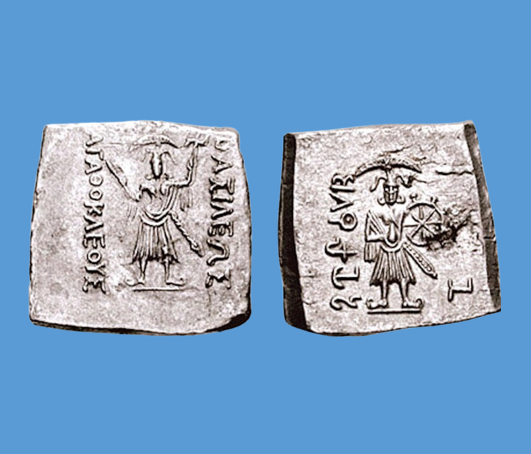
We see depiction of Lord Balarama on Indian punch-marked coins holding the proverbial plough. However, the first known depiction of Lord Shri Krishna has happened on the square drachma of Indo-Greek King Agathocles ca ~190-180 BCE.
On the coin, Lord Shri Krishna is holding a conch = shankha and the Sudarshan chakra – being Lord Vishnu Incarnate, he hold the icons / implements related to Lord Vishnu. While, the reverse depicts Lord Balarama holding a plough and a a mace. The coin is inscribed in two scripts – obverse has Greek text – BASELIOS AGATHOKLEOS while the Reverse has RAJANE AGATHUKLEYA IN ancient Brahmi script.
***(Bhagavat cult was practiced by many Greeks of the time, the Garuda column of Heliodorus at Besnagar, Madhya Pradesh is ample proof as the Heliodorus, the Greek ambassador of Antialkidas – ca. 115 to 95 BCE of Takshashila at Shunga King Bhagabhadra’s court was a devout Vaishnav. and,
The inscription reads: "This Garuda-standard of Vāsudeva, the god of gods, was constructed here by Heliodora (Heliodorus), the Bhagavata, son of Dion, a man of Taxila, the Greek ambassador..." speaks a lot about Vaishnav following in BCE period)
-
Bronze Coin of Zeionises, Kshatrapa of Chuksa
2026-10-22 ThuThe Indo-Scythians, also known as the Sakas, were Central Asian peoples who migrated into the nor...
-
Silver Drachma of the Western Kshatrapas Ruler Viradaman
2026-10-22 ThuThe Western Kshatrapas were an important dynasty that ruled parts of western and central India, p...
-
Silver Tetradrachm of the Northern Kshatrapas
2026-10-21 WedThe Kshatrapas of Kashmir form part of the fascinating history of the northwestern Indian subcont...
-
Numismatics Masterpiece - Gold Dodda Honnu of Krishnadevaraya, Vijayanagara Empire
2026-10-21 WedThe Vijayanagara Empire, founded in 1336, was one of the most influential powers in medieval Sout...
-
Celebrate the Spirit of Dussehra through Philately
2026-10-20 TueAs we celebrate the joyous festival of Dussehra, let us explore a special postage stamp that capt...