
2026-09-03 Thu
The Manikya dynasty of Tripura extends back several centuries. Traditional accounts recorded in the Rajmala, the royal chronicle of Tripura, trace the ancestry of the rulers to a much earlier period. Rulers such as Dharma Manikya and Dhanya Manikya expanded the kingdom and supported temples, literature, irrigation works and administration. Tripura developed into an important regional power in northeastern India.
The Manikya rulers maintained relations and conflicts with the neighbouring rulers of Bengal. Vira Chandra belonged to this long royal tradition. His reign was particularly significant because he pursued modernisation while maintaining the traditions of the Tripura court.
He was succeeded by his son Radha Kishore Manikya in 1896. The Manikya dynasty continued to rule Tripura until 1949. Following India's independence, Tripura acceded to the Indian Union on 15 October 1949, bringing the dynasty's political rule to an end.
Maharaja Vira Chandra Manikya Debbarma ruled Tripura from 1862 to 1896. His reign marked an important stage in the transformation of Tripura from a traditional kingdom into a more modern princely state.
One of his major achievements was the development of Agartala. He encouraged its urban growth and laid the foundations for a modern municipal administration. The Agartala Municipality was established during his reign. In 1890, he established Umakanta Academy. It became an important centre for Western-style education in Tripura.
He was also a patron of art, literature and photography. He was an enthusiastic photographer. He reportedly organised an annual photographic exhibition at his palace. His interest in photography was unusual among Indian rulers of his period.
He was also an important patron of Bengali culture. His association with Rabindranath Tagore became an important part of Tripura's cultural history. The royal family's patronage helped strengthen literary and cultural connections between Tripura and Bengal.
Vira Chandra Manikya married four times. His queens were Bhanumati I, Rajeshwari, Manomohini and Bhanumati II. The queen named on this coin is believed to be Bhanumati I. Her name also appears on coins issued immediately before the introduction of the machine-struck tankas.
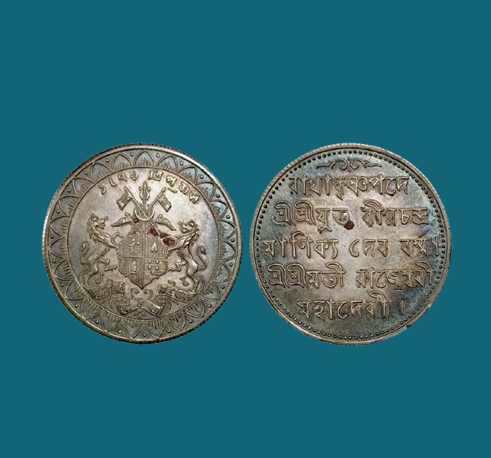
This rare silver tanka belongs to Vira Chandra Manikya, ruler of Tripura. It also names Queen Bhanumati, one of his consorts. The coin is a fine example of the ceremonial coinage of the princely state.
Vira Chandra Manikya succeeded his elder brother in 1862. However, his formal installation took place in 1870. This event is reflected in the dating of his coins.
The obverse of the coin features the coat of arms of Tripura. The shield is divided into four quarters. It shows a mermaid, an inverted heart, a right hand and five balls. The crest carries four pennons. A trident and crescent are also shown. Two lions serve as supporters. Below them is the state motto, ending with “…Saramekam Veerata.” The date 1279 Tripurabda appears above the arms.
The reverse carries a five-line Bengali inscription. It reads, “Radha Krishna Pade// Shri Shri Yuta Vira Chandra// Manikya Deva Varmma// Shri Shrimati Bhanumati// Maha Devi”. It weighs 10.11 grams. Its attractive rainbow toning adds to its visual appeal. The specimen is graded About Uncirculated and is considered extremely rare.
Its rarity and presentation character make it an important piece of Tripura's numismatic heritage.
-
Gold Tanka of Ishana Chandra Manikya and Queen Chandresvari of Tripura
2026-09-03 Thu -
Yadavas of Devagiri: Mahadeva’s Punch-Marked Gold Padma Tanka
2026-09-02 Wed -
Lion on Silver Coin of Devgiri Yadava King Singhana Deva II
2026-09-02 Wed -
Coin of the Last Chauhan of Ranthambhor, Hammira Deva
2026-09-01 Tue -
Silver Dramma of the Chauhans Jaitra Simha of Ranthambhor
2026-09-01 Tue