
2026-09-02 Wed
The Yadavas of Devagiri, also known as the Seuna Yadavas, were one of the most powerful dynasties of medieval Deccan India. Rising to prominence between the 9th and 12th centuries, they initially ruled as feudatories before establishing an independent kingdom with Devagiri (Daulatabad in Maharashtra, as their capital). Strategically located in the Deccan, Devagiri became an important centre of political power, trade, culture, and military activity.
The dynasty reached its greatest territorial extent during the reign of Singhana Deva II (c. 1200–1247 CE). He was one of the most successful rulers of the Yadava dynasty and transformed the kingdom into a major Deccan power. Through military campaigns, Singhana expanded Yadava influence over large parts of present-day Maharashtra and Karnataka and asserted his authority against neighbouring powers, including the Hoysalas and the Kakatiyas. His reign also witnessed considerable cultural and religious patronage, contributing to the development of Devagiri as a flourishing medieval centre.
Singhana's long reign was also significant for Yadava coinage. The dynasty issued coins in gold, silver, and base metals, generally combining concise legends with distinctive symbols. Their coinage reflects the cultural environment of the Deccan, where Sanskrit and regional scripts and religious imagery were important elements of royal representation.
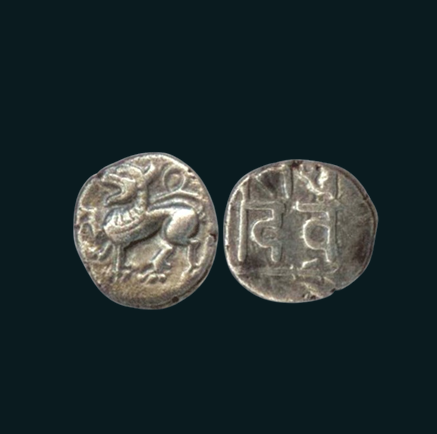
Here, the Silver coin weighs 0.89 grams. The obverse features a lion, a powerful emblem traditionally associated with strength, sovereignty, and royal authority. On the reverse is the ruler's name in Devanagari, reading “Sri Singha / na Deva”, although the legend is only partially visible on this coin.
-
Yadavas of Devagiri: Mahadeva’s Punch-Marked Gold Padma Tanka
2026-09-02 Wed -
Coin of the Last Chauhan of Ranthambhor, Hammira Deva
2026-09-01 Tue -
Silver Dramma of the Chauhans Jaitra Simha of Ranthambhor
2026-09-01 Tue -
Silver Rupee from Tibet
2026-08-31 Mon -
Divine Shiva & Parvati on a Tanjore Maratha Copper Mudra
2026-08-31 Mon