
2026-08-31 Mon
For centuries, Tibet occupied a distinctive position at the crossroads of the cultures and political ambitions of Central and South Asia. Its mountainous geography helped preserve a strong cultural and political identity, while its location brought it into contact with powerful neighbors including China, British India, Nepal and Bhutan.
During the late 19th and early 20th centuries, Tibet became increasingly important in the strategic rivalry between the British Empire and Qing China. The period was marked by competing claims of authority, diplomatic missions and military interventions. These political developments were also reflected in Tibet's coinage.
Tibet traditionally relied heavily on silver coins, many of which were locally produced. However, the circulation of foreign currencies, especially the British Indian rupee, had a significant influence on Tibetan monetary practices. Silver rupees from British India became widely accepted in Tibet because of their reliable silver content and commercial importance.
The years 1911–1916 were among the most significant in modern Tibetan history. The Xinhai Revolution of 1911 brought an end to the Qing dynasty in China, while the political relationship between Tibet and China entered a period of considerable uncertainty. These wider developments make coins associated with this era especially valuable for understanding the changing political landscape of the region.
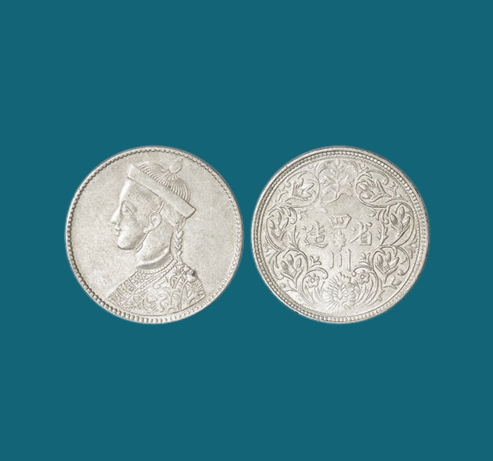
The showcased Tibet Silver Rupee, dated ND (1911–1916 AD) and catalogued as KM Y3.2, belongs to this fascinating period of transition.
It weighs 11.37 grams. The coin reflects the influence of the Indian rupee standard while incorporating imagery associated with Tibetan and Chinese political traditions.
The obverse features a small portrait bust of the king, shown wearing a distinctive collar. The use of a portrait gives the coin a strongly political character, placing the ruler at the center of its design. The reverse presents four Chinese ideograms, arranged vertically and read from top to bottom and right to left . A vertical rosette occupies the center of the design, while the entire inscription is enclosed within an ornamental floral wreath.
This coin is therefore much more than a piece of currency. Its combination of a royal portrait, Chinese ideograms, central rosette and floral wreath reflects the complex intersection of political authority, commerce and cultural influence in early 20th-century Tibet.
Such, Tibetan silver rupees are fascinating examples of how regional coinage could reflect the competing influences of Tibet, China and British India. This particular issue stands as a tangible reminder of a remarkable period when the traditional monetary systems of the Himalayan world were encountering profound political and economic change.
-
Divine Shiva & Parvati on a Tanjore Maratha Copper Mudra
2026-08-31 Mon -
Baroda Last Ruling Maharaja Pratap Singh Gaekwad’s Rare Mohur
2026-08-29 Sat -
Shiva-Parvati in Gold: The Sacred Varaha of Krishna Raja Wodeyar III
2026-08-29 Sat -
An Iconic Coin of the Sangam Pandyas Features Elephant, Trident and Man
2026-08-28 Fri -
An Ancient Sangam-Age Chera’s Copper Coin
2026-08-28 Fri