
2026-08-13 Thu
The Satavahanas transformed the Deccan into a major political and commercial power. Sri Satakarni’s reign marked an important phase of expansion and Vedic revival. The Satavahana dynasty was one of the most significant post-Mauryan powers in ancient India. They established the first major indigenous empire in southern and central India.
The dynasty’s core territory covered present-day Maharashtra, Telangana, and Andhra Pradesh, with expansion into parts of Karnataka, Madhya Pradesh, and Gujarat. Their principal capital was Pratishthana (modern Paithan on the Godavari River in Maharashtra), strategically located on major trade routes. Later, Amaravati in the eastern Deccan also gained prominence.
The Satavahanas acted as a cultural and commercial bridge between North and South India. They controlled important ports that facilitated Indo-Roman trade, issued some of the earliest Indian coins bearing royal portraits and legends, and patronized both Brahmanical traditions and Buddhism. Rock-cut caves at Nashik, Karle, Kanheri, and Bhaja, as well as the great stupa at Amaravati, stand as enduring monuments of their era.
Sri Satakarni is generally regarded as the third king of the dynasty and is dated by most scholars to the 1st century BCE, commonly around 70–60 BCE or a similar span within the broader 100–50 BCE range.
He is credited with conquering parts of western Malwa and other regions, taking advantage of political turmoil in the north. The famous Naneghat inscription, composed by his queen Naganika (Nayanika), daughter of a Maharathi chief, provides the richest contemporary record of his reign. It describes him as the “Lord of Dakshinapatha” (Dakshinapathapati) and “wielder of the unchecked wheel of sovereignty” (apratihatacakra). The inscription records that he performed major Vedic sacrifices, including the Rajasuya and two Ashvamedha, along with numerous other rituals.
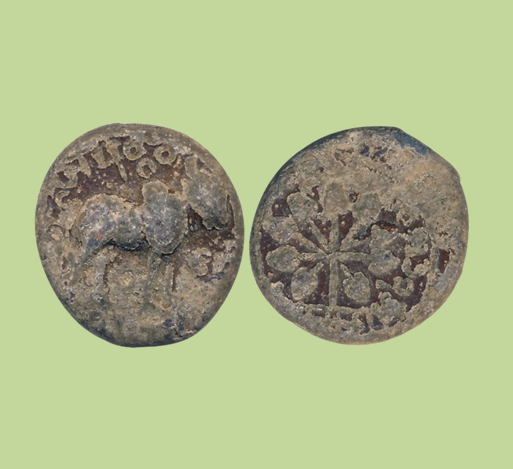
The dynasty issued coins primarily in lead, potin, copper, and silver. Common motifs include the elephant, humped bull, lion, tree-in-railing, Ujjaini symbol, nandipada, swastika, and triangle-headed standard. Lead coins from the Nevasa-Paithan region are particularly characteristic of the early western Deccan issues.
Here, the coin weighs approximately 7.47 grams. The obverse depicts a humped bull standing facing right, with an Ujjaini symbol positioned above it, accompanied by a Brahmi legend. The reverse features a tree in railing featuring bold leaves often shown with five prominent branches or leaves. Such coins provide evidence of Sri Satakarni’s authority in the western Deccan.
-
Lead Coin with Bow and Arrow of the Rano Vasithiputra Kura
2026-08-13 Thu -
Copper Nazarana Paisa of Jaipur: The Jhar-Marked Coinage of Sawai Jaipur
2026-08-12 Wed -
Rare Copper Nazarana of Tukoji Rao II from Indore
2026-08-12 Wed -
Rare Nazarana Rupee of the Holkar State, depicting King Jaswant Rao as a bee at the feet of Lord Vishnu
2026-08-11 Tue -
Silver Nazarana Mudra of Tukoji Rao II, Holkar State
2026-08-11 Tue